
What To Know Before Visiting Angkor Wat At Sunrise
Cambodia's northwest is defined by the remains of the Khmer Empire, a civilisation that shaped much of mainland Southeast Asia between the 9th and 15th centuries. At its centre, roughly 6km north of Siem Reap, sits Angkor Wat. Built in the early 12th century and covering more than 160 hectares, it is the largest religious structure in the world, originally dedicated to the Hindu god Vishnu and functioning as a Theravada Buddhist site since the late 13th century.
For most visitors, the first glimpse of Angkor Wat comes before dawn. The open ground west of the temple and its five towers create the conditions for one of Southeast Asia's most recognised views, with the silhouette reflected in the pools below. It is the reason thousands of people set their alarms for 4:00am each morning in Siem Reap, and a handful of Angkor Wat sunrise tips make the early start all the more worthwhile.
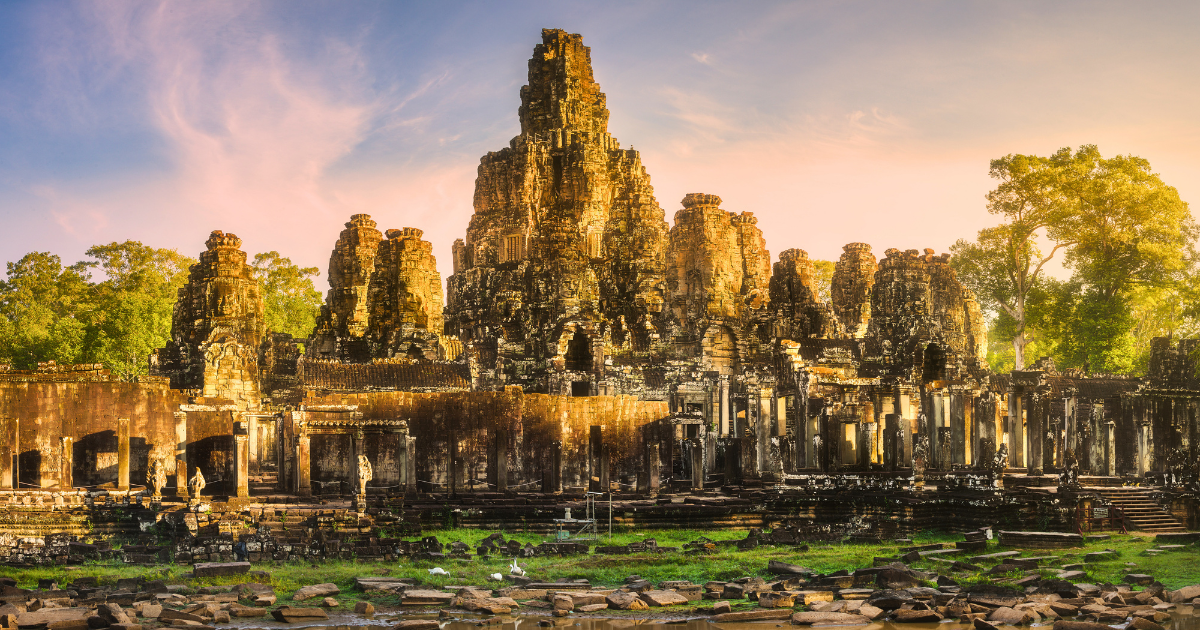
Angkor Wat opens at 5:00am year round, giving visitors a comfortable window to settle in before the sun rises behind the towers.
Understanding the history of Angkor Wat
Angkor Wat is a 12th-century Hindu temple built by King Suryavarman II of the Khmer Empire. It was designed as both a state temple and royal mausoleum, dedicated to the god Vishnu, and remains the largest religious structure in the world.
Who built Angkor Wat?
Angkor Wat was commissioned by King Suryavarman II, who ruled the Khmer Empire from 1113 until around 1150. He came to power by overthrowing his great uncle, Dharanindravarman I, and used the construction of the temple to legitimise his reign and honour his personal deity, Vishnu.
When was Angkor Wat built?
Construction began around 1116 and continued for roughly 30 years, though the temple was never fully completed. The entire structure is built from sandstone and laterite, with nearly every surface carved with narrative scenes or decorative detail. The scale of the work is difficult to overstate. There are more than 1,200 square metres of bas-relief carvings alone, depicting stories from Hindu tradition alongside scenes of the Khmer court and military processions.
Which Angkor Wat history facts are worth knowing before a visit?
The temple was designed as a physical representation of Mount Meru, the home of the gods in both Hindu and Buddhist cosmology. The five central towers stand for the mountain's peaks, the enclosing walls represent surrounding ranges, and the 200 metre wide moat symbolises the ocean at the edge of the world.
Unlike most temples in the Angkor complex, Angkor Wat was never fully abandoned. The broader city declined from the 15th century, but the temple continued to function as a place of worship, gradually shifting from Hindu to Theravada Buddhist use. That continuity is a large part of why it survives in the condition it does today, and why it still operates as an active religious site.
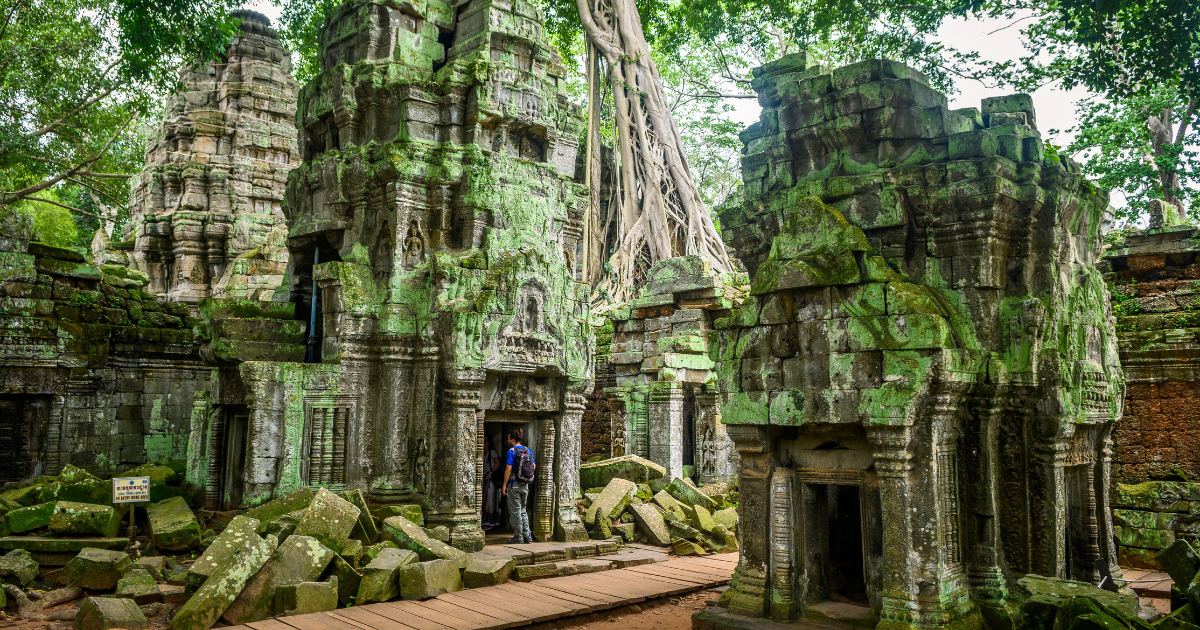
Ta Prohm temple ruins is covered with moss and large tree roots overgrows the walls.
Why sunrise is such a popular time to visit Angkor Wat?
Angkor Wat's orientation and setting make sunrise one of the most rewarding times to visit. The temple faces west, so visitors approaching from the main entrance look east toward the rising sun, with the five towers framed directly against the early sky.
Is sunrise the best time to visit Angkor Wat?
For most first-time visitors, yes. The complex was aligned with considerable astronomical precision, and twice a year during the March and September equinoxes, the sun rises directly behind the central tower. Even outside those dates, the eastern sightline from the entrance causeway and reflection pools produces the view that has come to define Angkor Wat in photographs.
What are the advantages of visiting at sunrise?
Temperatures in Siem Reap regularly exceed 30 degrees by mid-morning, so the hours around dawn are noticeably cooler for covering the complex on foot. The light changes quickly during the first 45 minutes, moving from deep blues through pinks and golds as the sun clears the towers. For photographers, this window is difficult to replicate at any other time of day.
There is also a timing advantage. Most group tours and independent visitors arrive between 9:00am and early afternoon. By starting at sunrise, it is possible to spend an hour watching the light shift, then move into the temple itself while the interior spaces are still relatively quiet.
When to arrive and how to plan your morning
Planning the morning well means arriving at the temple gates by 5:00am, which requires leaving Siem Reap no later than 4:30am and buying an Angkor pass the afternoon before. The details are straightforward, but they do require some preparation the evening prior rather than on the morning itself.
What time should you visit Angkor Wat for sunrise?
Sunrise in Siem Reap falls between roughly 5:30am and 6:30am depending on the time of year. In December and January the sun rises closer to 6:30am, while in June it can appear as early as 5:37am. The temple gates open at 5:00am year round, so there is always a comfortable window before the sun appears.
Most of the colour happens in the 30 to 45 minutes either side of the actual sunrise time, and arriving right as the gates open means catching the full transition from dark sky to daylight. Checking the exact time for the specific date of a visit helps, as even a few weeks can shift the timing noticeably.
How early should visitors leave Siem Reap for Angkor Wat?
Angkor Wat sits roughly 6km north of central Siem Reap, and the drive by tuk tuk or car takes around 15 to 20 minutes. At 4:30am the roads are quiet and the journey is easy. Leaving by 4:15am to 4:30am allows plenty of time to pass the checkpoint, walk across the causeway, and settle into a good position before the sky begins to change.
Most hotels and guesthouses in Siem Reap can arrange a tuk tuk for the morning, and this is also a good time to buy the Angkor pass. Picking it up the afternoon before means one less thing to think about at dawn and avoids any queue at the ticket office in the dark.
How much time should travellers allow for the visit?
The sunrise itself unfolds over roughly 45 minutes to an hour, but the temple rewards a longer stay. The morning light after sunrise is soft, and the galleries and bas-reliefs are easier to appreciate in the cool of the early hours.
Most visitors who arrive for sunrise spend two to three hours at Angkor Wat before moving on to other temples or heading back to Siem Reap for breakfast. The pass grants access to the entire Angkor Archaeological Park, so leaving by mid morning means arriving at Angkor Thom or Ta Prohm while they are still pleasantly uncrowded.
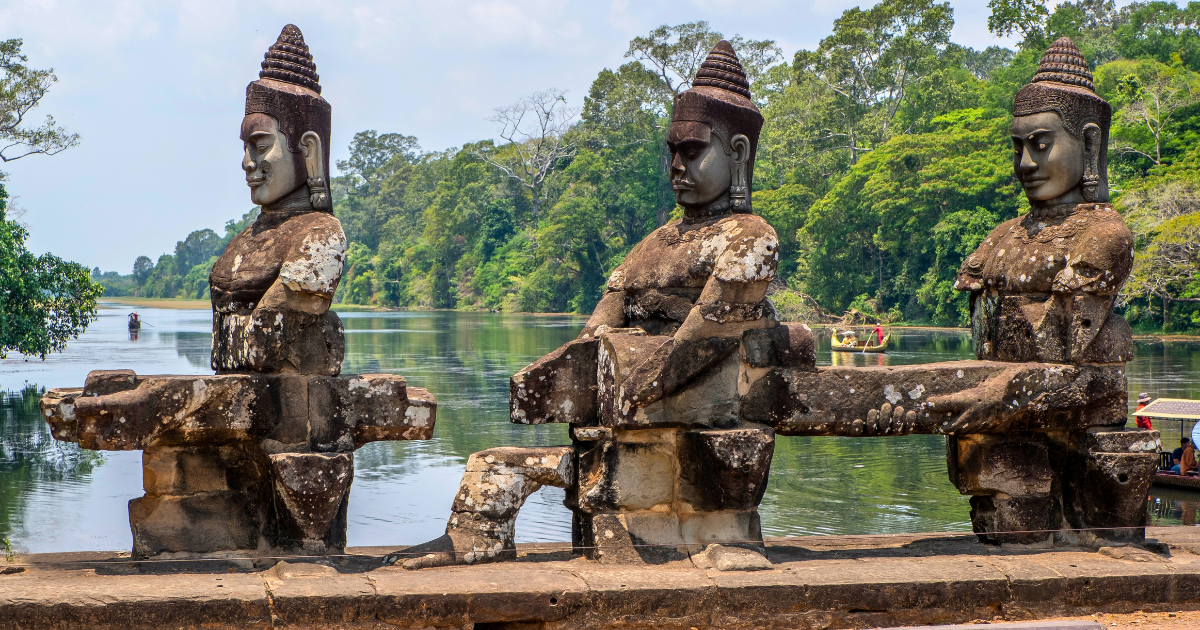
The 54 stone figures lining the bridge to Angkor Thom's south gate represent the Hindu myth of the Churning of the Sea of Milk, a story also depicted in the bas-reliefs at Angkor Wat.
What to expect from the sunrise experience?
The sunrise at Angkor Wat is one of the most photographed moments in Southeast Asia, and it draws a sizeable crowd every morning. Knowing what to expect helps visitors enjoy the experience rather than be caught off guard by it.
How crowded is Angkor Wat in the morning?
The reflection pool area gets busy, particularly during the dry season peak of December and January when several hundred visitors gather before dawn, sometimes well over a thousand. The busiest period runs from November through March, when clear skies coincide with the main tourist season.
The crowds are concentrated in one area and thin out quickly. Most people leave within 30 minutes of sunrise to head to breakfast or other temples, so those who stay a little longer often find themselves with far more space to explore the temple itself.
Where do most visitors watch the sunrise?
Most visitors position themselves beside the northern reflection pool, just inside the western entrance, where the five towers are mirrored in the still water below. This is where the classic image of Angkor Wat comes from. The southern pool offers a similar angle with noticeably fewer people, though the reflection can be less symmetrical depending on water levels and the season.
For a quieter vantage point, the elevated ground near the northern and southern libraries provides an unobstructed view of the towers against the sky, without the jostle for front row space at the water's edge. The view is different without the reflection, but the added space makes it a lovely spot to take in the moment at a slower pace.
What is Angkor Wat like once the sun comes up?
The atmosphere shifts quickly once the sun clears the towers and the sky brightens. The crowd at the pools disperses and the temple opens up. Morning light warms the sandstone and picks out the detail in the 1,200 square metres of bas-relief carvings that line the gallery walls.
Exploring the interior galleries and upper levels while they are still cool and uncrowded is often the most rewarding part of the visit. The hours immediately after sunrise offer a quality of light and a sense of space that is difficult to find later in the day.
What to wear and bring for an early start
Lightweight, breathable clothing and a few essentials packed the night before make for a comfortable and hassle free morning. The dress code at Angkor Wat is strictly enforced, so getting this right avoids any delays at the entrance.
What should you wear at Angkor Wat?
Loose cotton or linen trousers that cover the knee with a short-sleeved shirt work well for both the dress code and the climate. Temperatures at dawn can feel pleasantly cool, but Siem Reap heats up quickly once the sun is up, so layers that are easy to adjust help.
Sturdy, comfortable shoes are important too, as the temple involves a good deal of walking over uneven stone, and sandals can make the steep staircases more difficult.
Is there an Angkor Wat dress code?
Yes, and it applies to both men and women. Shoulders and knees must be covered to enter the temple complex. A scarf or light shawl can work as a quick cover-up for sleeveless tops in most areas, though access to the upper level of the central tower requires proper sleeved clothing rather than a draped scarf.
The code has been in place since 2016 across every temple in the Angkor Archaeological Park, and staff at the entrances are helpful in letting visitors know if anything needs adjusting.
What should first-time visitors bring to Angkor Wat?
A small daypack with a few essentials goes a long way. Water is the priority, as two to three litres across the visit is a reasonable amount in the tropical humidity. A torch or headlamp helps with navigating the dark paths between the entrance and the reflection pools before dawn.
Sunscreen, a hat, and insect repellent are all worth having, as mosquitoes can be active around the pools at first light. A portable phone charger is practical for anyone planning to photograph the sunrise and continue exploring afterward, and packing snacks or a light breakfast saves time.
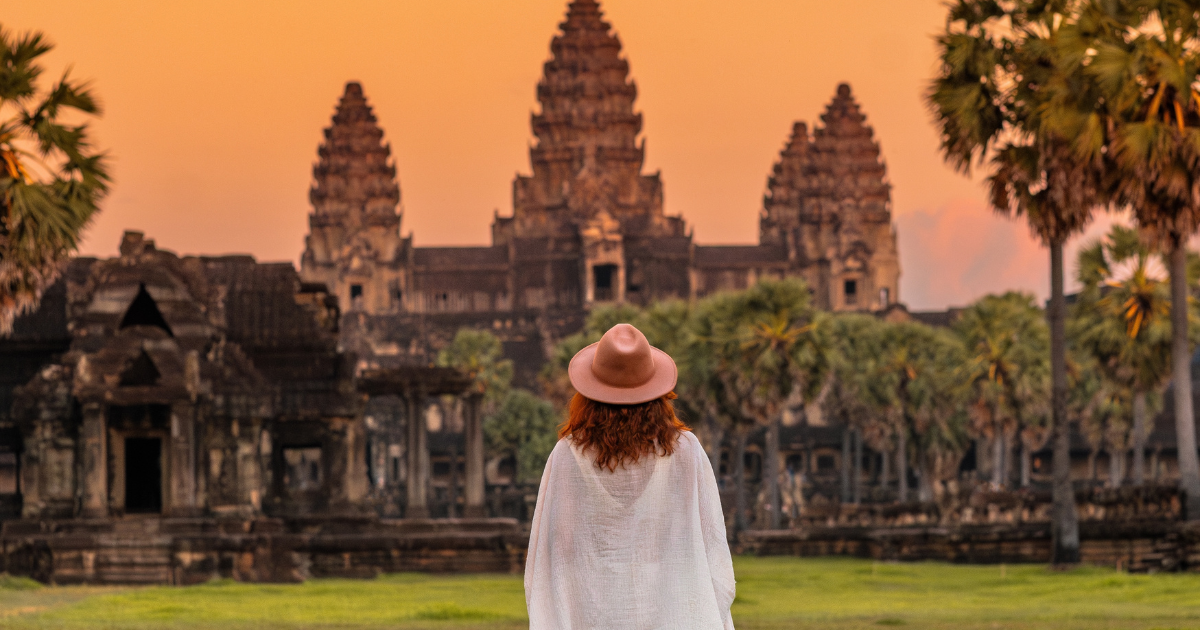
Shoulders and knees must be covered to enter the temple complex, a rule that has been strictly enforced across the Archaeological Park since 2016.
Practical tips for visiting Angkor Wat at sunrise
Buying the Angkor pass the day before, knowing which entrance to use, and allowing enough time after sunrise to explore the temple properly are the three things that make the biggest difference. A little planning the day before covers all three, and joining a private tour in Cambodia takes care of the logistics entirely.
How do entry passes work in the early morning?
The Angkor pass is required for entry to every temple in the Archaeological Park, including Angkor Wat. Passes are priced in US dollars, which is the standard tourism currency in Cambodia. A one-day pass costs US$37 (around A$58), a three-day pass is US$62 (around A$98), and a seven-day pass is US$72 (around A$114). Children under 12 enter free with passport proof.
The main ticket office on Road 60 opens at 4:30am, but the most convenient option for a sunrise visit is to buy the pass the afternoon before, when tickets purchased after 4:45pm are valid for the following day. Passes can also be purchased online through the official Angkor Enterprise website or at self-service kiosks, including one at Heritage Walk Mall in central Siem Reap.
Which entrance is usually used for sunrise visits?
Almost all sunrise visitors enter from the west, crossing the long stone causeway that leads directly toward the main towers. This is the principal entrance and the one that lines up with the classic view of the temple against the rising sun.
After crossing the causeway, the path opens out to the northern and southern reflection pools, which is where most people settle in to watch. The walk from the outer gate to the pools takes around ten minutes, so it is worth factoring that in when planning arrival time.
Can visitors explore Angkor Wat properly after sunrise?
Yes, and many visitors find that the time after sunrise is the highlight of the morning. Once the crowd at the pools moves on, the temple is open to explore at a relaxed pace. The upper levels, which open from around 7:30am, offer wide views across the complex and surrounding forest. From there, the natural next step is to continue to Angkor Thom or Ta Prohm, both within a short tuk tuk ride, while the morning is still cool.
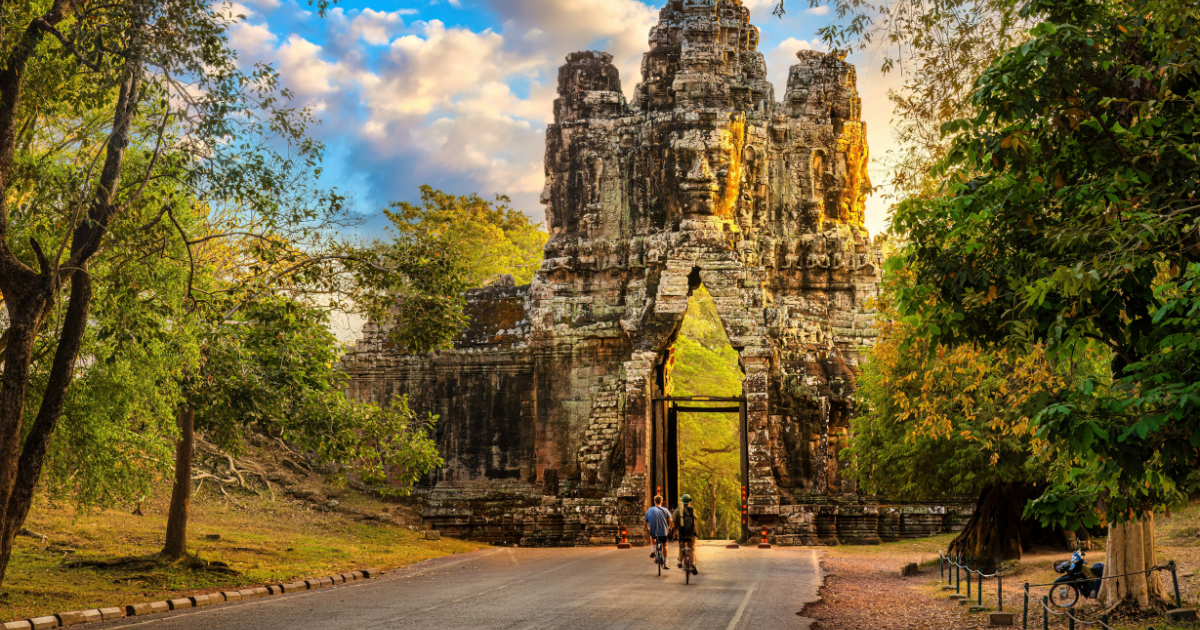
The Angkor pass grants access to the entire 400 square kilometre Angkor Archaeological Park, including Angkor Thom, Ta Prohm, Bayon, and dozens of smaller temples.
Explore Angkor Wat with Asia Unbound
Sunrise at Angkor Wat is one of those moments that stays with people long after they return home. Asia Unbound designs private, custom-made journeys across Cambodia and the wider region. Every itinerary is shaped around individual interests and pace, with local guides, handpicked hotels, and the freedom to change direction mid-trip. Contact us today to start planning a journey through Cambodia and beyond.