
The Architecture Of Bulguksa Temple In Gyeongju
Set on the wooded slopes of Tohamsan in Gyeongju, Bulguksa Temple is one of the clearest surviving examples of how Buddhist belief shaped architecture during the Silla period. Its stone terraces, pagodas, bridges and timber halls were arranged with care, creating a temple complex that reflects both religious meaning and royal patronage.
The temple stands within one of South Korea’s most historically significant cities. As the former capital of the Silla kingdom, Gyeongju is known for its royal tombs, archaeological remains and Buddhist monuments, but Bulguksa holds a distinct place for the precision of its design and the depth of its cultural importance.
The layout of courtyards, stairways, halls and pagodas shows how architecture was used to shape movement through the site and express Buddhist ideas in built form. For travellers interested in Korean history, temple design and the wider historic landscape of Gyeongju, Bulguksa is one of the most important places to understand.
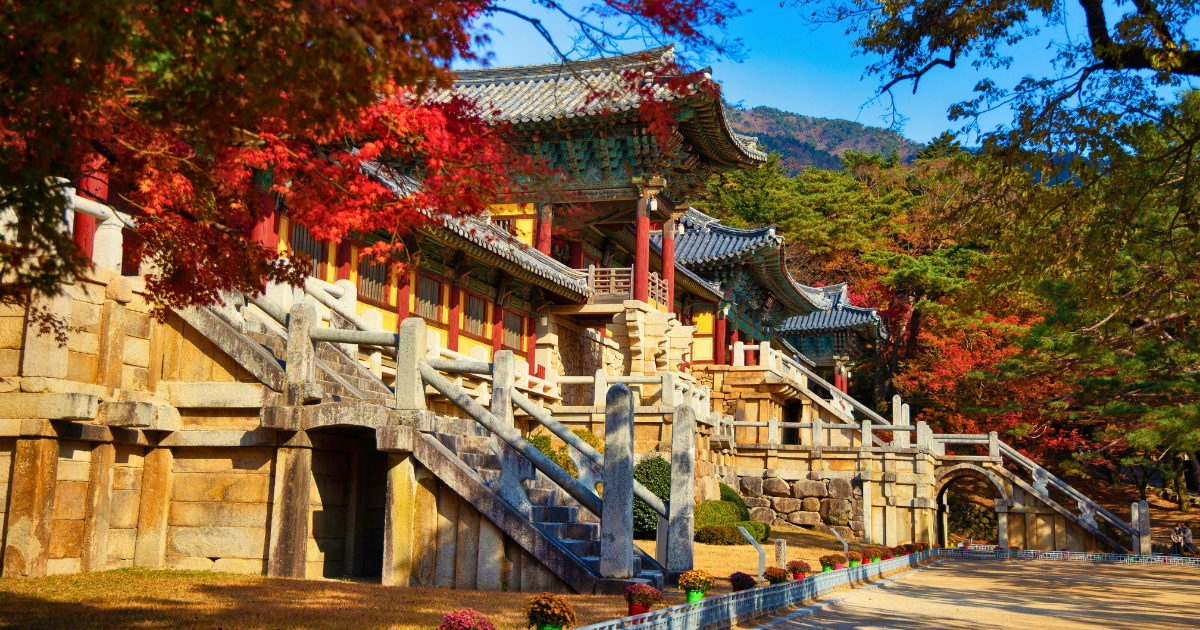
Set on the slopes of Tohamsan, Bulguksa is best understood as a carefully planned temple complex rather than a single hall.
Bulguksa Temple and its place in the history of Gyeongju
Bulguksa Temple is a Buddhist temple complex on the slopes of Tohamsan, about 13km southeast of central Gyeongju. It was one of the major state-sponsored temple projects of the Silla kingdom and remains one of the most important religious sites in South Korea. Today, Bulguksa functions as both an active temple and a historic monument, studied for what it reveals about Silla period religion, craft and architecture.
How old is Bulguksa Temple?
An earlier temple is believed to have stood on the site from around the 6th century, during the reign of King Beopheung, making the origins of Bulguksa roughly 1,500 years old. The complex most closely associated with the site today dates from a major rebuilding in 751, during the Unified Silla period, when the court at Gyeongju was at the height of its power.
This rebuilding is traditionally linked to Kim Dae-seong, a Silla official credited with overseeing the project as an act of Buddhist devotion. It would have depended on royal patronage as well as the labour of many craftsmen, monks and builders, placing Bulguksa among the most significant Silla dynasty temples and within a broader culture of religious construction in 8th-century Gyeongju.
What is Bulguksa Temple known for?
Bulguksa Temple is known for the precision of its layout, its stone terraces and stairways, and the two pagodas that stand in its main courtyard. It is also recognised for the way it expresses Buddhist ideas through built form, using elevation, sequence and threshold to move visitors from the ordinary world into sacred space.
As one of the most studied examples of Korean temple architecture from the Unified Silla period, Bulguksa is significant for what it reveals about how religious belief, royal patronage and architectural planning came together in 8th-century Gyeongju.
Why is Bulguksa a UNESCO site?
In 1995, Bulguksa was inscribed on the UNESCO World Heritage List alongside Seokguram Grotto, recognising both sites as outstanding examples of Buddhist architecture in East Asia. The listing reflects the artistic and historical significance of these two places within the broader Buddhist heritage of the Silla period.
Seokguram, set higher on the slopes of Tohamsan and linked to Bulguksa by a mountain trail, houses a stone Buddha that faces the East Sea. The two sites are closely connected in origin and religious purpose, and many visitors choose to see both in a single visit. UNESCO recognition has placed Bulguksa within an international context, confirming that its importance extends well beyond Korea.
What survives from the Silla period?
Much of what visitors see at Bulguksa reflects that 8th-century foundation, though the site has been damaged, repaired and partially rebuilt over the centuries. The stonework, including the terraces, stairways, bridges and both pagodas, survives from the Unified Silla period and still defines the character of the complex.
Several timber halls were destroyed during the Imjin War in the 1590s and rebuilt in later periods, while further restoration took place during the 20th century. The result is a site that brings together original Silla stonework and later reconstruction within a layout that still follows the original plan.
What makes Bulguksa distinctive as a work of Korean architecture
Bulguksa stands apart from many other Korean temples because of the scale and precision of its stonework, the clarity of its layout, and the way its design expresses Buddhist ideas in built form. Within the broader history of Korean temple architecture, few sites preserve such a developed example of how stone, timber, elevation and spatial sequence were used together within a single complex during the Unified Silla period.
The role of stonework
One of the most striking aspects of Bulguksa is the prominence of its stone construction. The terraces, stairways, bridges and pagodas that form the lower and middle levels of the complex are all in stone, giving the site a solid, monumental quality that distinguishes it from later Korean temples where timber dominates.
The stonework was not decorative. It raised the most important parts of the temple above the surrounding ground, created formal approaches and thresholds, and separated the ordinary world from the sacred spaces above. The scale of this stone base gives Bulguksa a very different character from temples built primarily in wood on flatter ground.
Spatial planning and the use of levels
The complex is arranged across several levels, with each stage of approach leading visitors towards more important spaces. Courtyards sit between the buildings, stairways and bridges connect lower and upper sections, and gates mark thresholds along the way. Cheonwangmun Gate is one of the clearest examples, separating the outer and inner areas of the complex.
Bulguksa was planned as a series of connected spaces rather than around a single focal point, with halls, pagodas and gates placed in relation to one another to guide movement and reinforce the religious order of the site.
Stone and timber together
The relationship between stone and timber at Bulguksa is central to its architectural character. Stone forms the base, the platforms, the stairways and the pagodas. Timber frames the halls above, creating the enclosed worship spaces.
The contrast between the two materials gives the complex much of its visual rhythm. The stonework is heavy, permanent and geometric. The timber above is lighter and more detailed. Together, they create a layered composition where the most sacred spaces sit above a strong, elevated base.
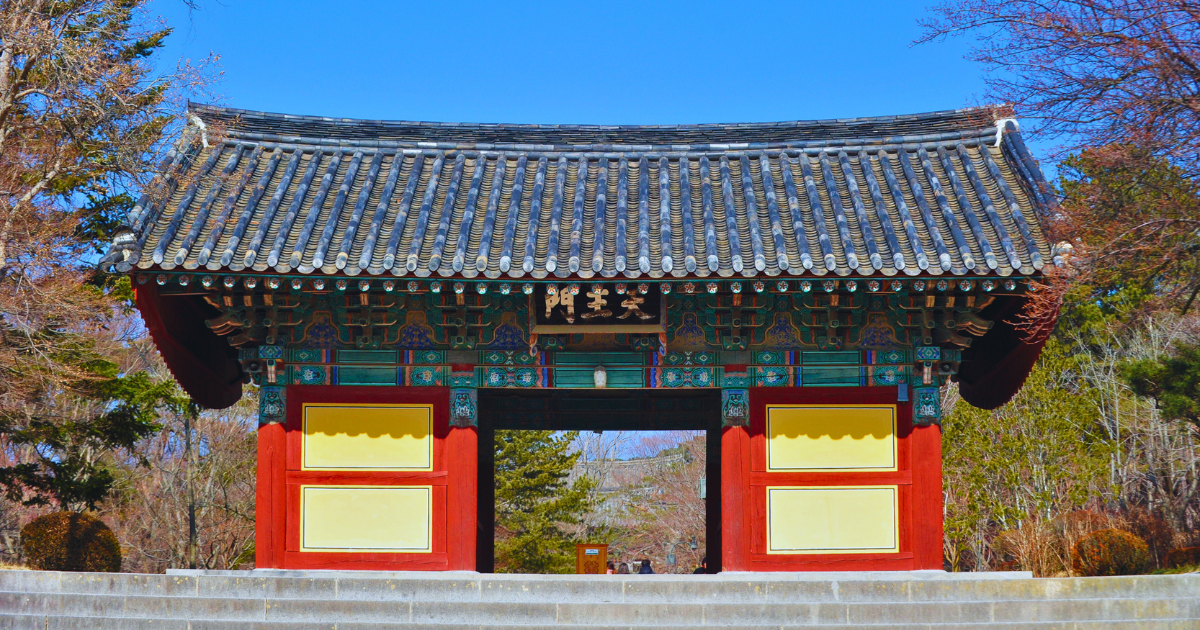
Cheonwangmun Gate marks one of the thresholds within Bulguksa, reinforcing the temple’s sequence of approach, entry and ascent.
What do the architectural elements of Bulguksa Temple represent?
The architectural elements of Bulguksa Temple represent Buddhist ideas about transition, hierarchy and enlightenment. Bridges, terraces, pagodas and halls were arranged to guide movement through the complex and to distinguish between outer and inner, lower and higher, ordinary and sacred space. Together, these elements show how religious meaning was built into the structure of the temple itself.
What is the meaning of the bridges in Bulguksa Temple?
The bridges at Bulguksa Temple represent the movement from the everyday world into a sacred space. They are placed at an important point in the approach to the temple, so visitors do not enter the main area all at once. Instead, they cross the stone bridges and climb upward before reaching the higher parts of the complex.
The best known examples are Cheongungyo and Baegungyo, which form the stone stair-bridge leading to Jahamun Gate and the terrace above it. Set at the front of the complex, they create one of the clearest transitions in the temple’s design, carrying visitors from the lower level of approach to the more elevated inner precinct.
What do the Bulguksa pagodas represent?
The Bulguksa pagodas represent two different visual expressions of Buddhist belief. They stand in the main courtyard in front of Daeungjeon, the Hall of Great Enlightenment, where they form the visual centre of the temple’s principal worship area. Seen from the terrace, they are positioned side by side, but each has a very different character.
Seokgatap, on one side of the courtyard, is simple, restrained and geometric, with a clear three storey form. Dabotap, opposite it, is more elaborate, with multiple levels, carved details and a more intricate silhouette. The contrast is one of the most distinctive features of Bulguksa Temple, showing how different architectural forms could express different aspects of Buddhist belief within the same sacred space.
How do the main halls reflect Buddhist ideas?
The main halls at Bulguksa reflect Buddhist ideas through both their placement and their function. They are set above the lower approaches on raised stone terraces, which gives them clear visual and spiritual importance within the layout. This use of height helps separate the worship spaces from the more transitional spaces below, reinforcing the sense that visitors are moving towards a more sacred part of the temple.
Daeungjeon sits at the centre of the main courtyard behind the two pagodas and serves as the principal worship hall of the complex. Other halls are arranged in relation to adjoining courtyards and terraces, each with its own place within the wider religious order of the site. This matters because Bulguksa was not designed around a single building. It was planned as a sequence of connected spaces in which the halls form the spiritual focus.
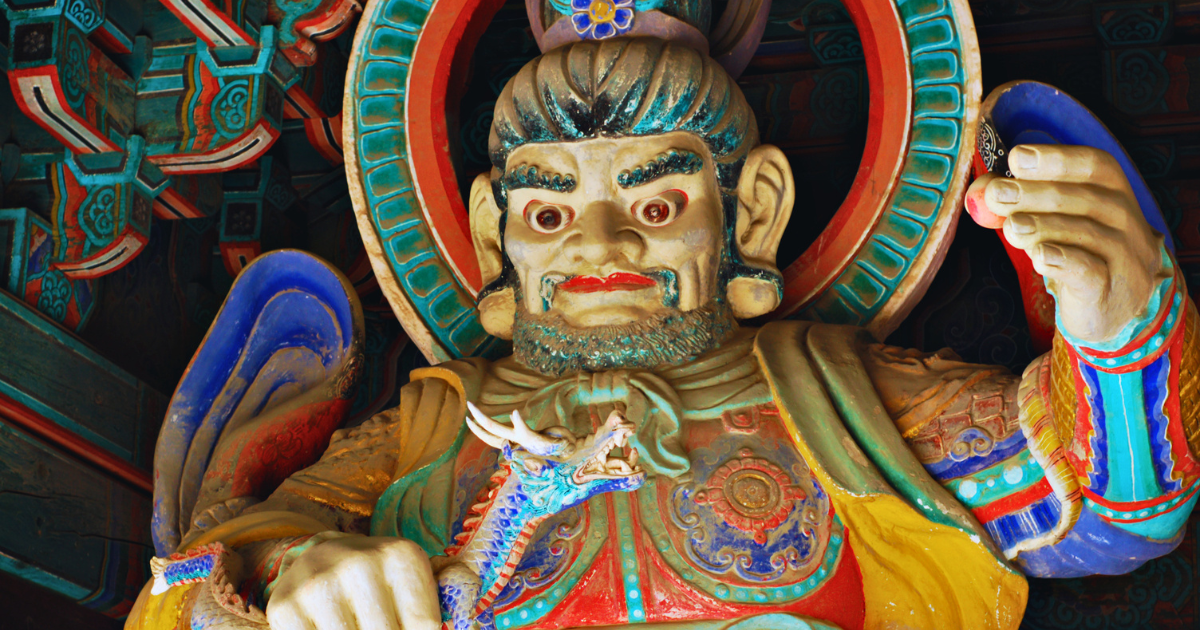
Guardian figures at Bulguksa reflect the religious purpose of the site and the symbolic role of gates and threshold spaces.
How has Bulguksa Temple changed over time?
Bulguksa Temple has changed over time through loss, rebuilding and careful restoration, yet the site still preserves the structure of the original Silla complex. What visitors see today is not a fully untouched 8th-century temple. Some parts survive from the Unified Silla period, especially in stone, while many of the wooden halls were rebuilt later.
What parts of Bulguksa Temple are original?
The most important original parts of Bulguksa Temple are its stone structures. These include the terraces, stairways, bridges and pagodas that still shape the layout of the complex. At the front of the temple, Cheongungyo and Baegungyo remain part of the main ascent leading towards Jahamun Gate. In the central courtyard, Seokgatap and Dabotap still stand before Daeungjeon, holding their place within the main worship area.
How has restoration shaped the site seen today?
Restoration has shaped Bulguksa Temple most clearly in its wooden buildings. Over the centuries, fires and conflict damaged much of the timber architecture, and several halls were rebuilt. As a result, the upper structures seen today do not all survive in their original 8th-century form. This helps explain the character of Bulguksa as it appears now. The temple brings together surviving stonework and later reconstruction in a way that still respects the older plan.
What to know before visiting Bulguksa Temple
Bulguksa is one of the most visited historic sites in Gyeongju, and spending time here is one of the best ways to understand how architecture, religion and landscape came together in the former Silla capital. A few practical details are worth knowing before you go.
Opening hours and admission
Bulguksa is open daily, generally from 9:00am to 6:00pm, though hours can vary slightly by season. Admission has been free since 2023, when the previous entrance fee was removed. Visitors should check the temple's official website or a local tourism office before visiting, as schedules may shift around public holidays.
How to get to Bulguksa Temple
The temple sits about 13km southeast of central Gyeongju. Local buses 10, 11 and 700 run from the Gyeongju Intercity Bus Terminal and pass through several of the city's main historic areas on the way, including the area around Hwangnidan-gil and the Daereungwon tomb complex. The journey takes around 40 minutes.
A taxi from central Gyeongju is quicker, at around 20 to 30 minutes. For travellers arriving from further afield, the nearest KTX station is Singyeongju, from where a bus or taxi covers the remaining distance to the temple.
How long to spend at Bulguksa
Most visitors find that one and a half to two hours allows enough time to move through the courtyards, terraces and halls without feeling rushed. Those combining Bulguksa with Seokguram Grotto, which is reachable by bus or a forest trail from the temple area, should allow a full morning or afternoon.
When to visit and what to expect
Spring, when the cherry blossom lines the path to the temple, and autumn, when the surrounding woodland turns colour, are the most popular times to visit. The site can become busy with tour groups, particularly around midday, so arriving earlier in the morning tends to offer a quieter experience.
Photography is permitted in the outdoor areas of the complex but restricted inside the temple buildings. A tourist information centre is located near the entrance, and there are restaurants and small shops across the road from the main approach.
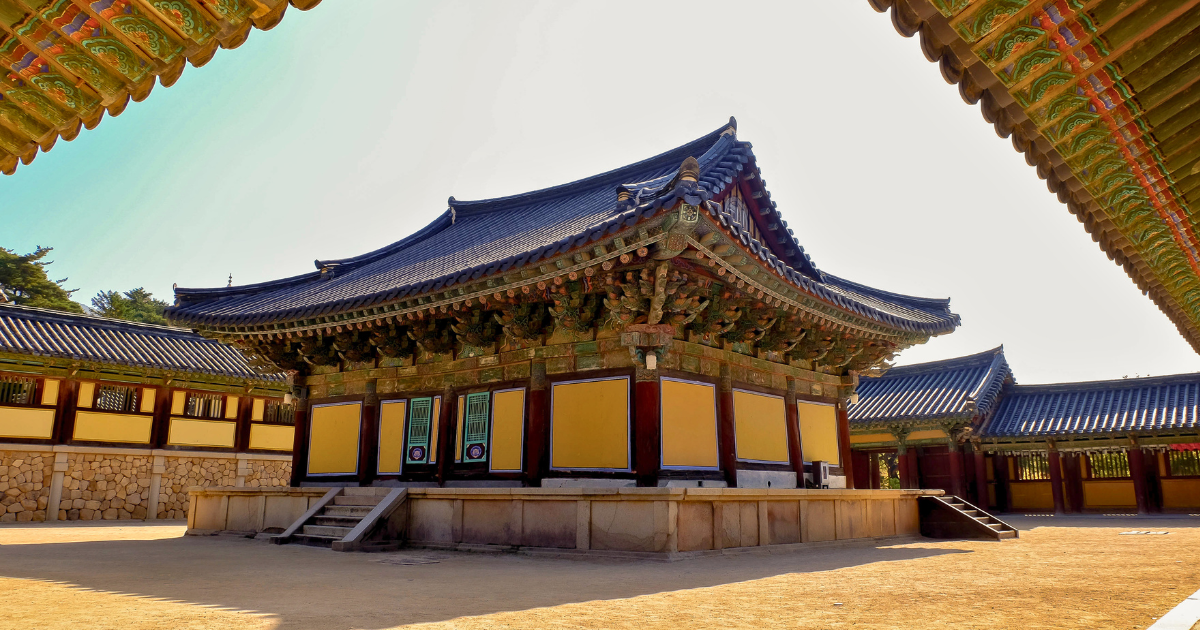
For many travellers, Bulguksa stands out because its courtyards and halls still convey the structure of the original temple complex.
Visiting Gyeongju with Asia Unbound
Gyeongju is best experienced with time to connect its architecture, religion and history across the former Silla capital. The city reveals how Buddhist belief, court culture and architectural planning shaped one of the most important historic landscapes in South Korea.
At Asia Unbound, we design private journeys through South Korea that place major historic sites within a wider cultural and regional context. If you are planning a trip to South Korea, contact us to tailor an itinerary that includes Gyeongju alongside the country’s other historic and cultural highlights.