
Khaling Weaving Traditions And Textile Heritage In Bhutan
Eastern Bhutan rewards the travellers who make it this far. The road from Paro and Thimphu climbs across a series of high passes, through Bumthang and Mongar, before opening into the districts of Trashigang and Lhuentse. This is the home of the Sharchop, Bhutan's largest ethnic group, and a region where daily life moves to the rhythms of farming, Buddhism, and the loom.
Women of the east are celebrated as Bhutan's finest weavers, and in most households the back strap loom holds pride of place beside the hearth. Girls learn from their mothers, often beginning at eight or nine, and weaving fills the winter months with colour once the harvest is in. The textiles they produce carry meaning well beyond cloth, signalling rank, marking ceremonial occasions, and serving historically as currency, dowry, and tax payment across Bhutanese society.
Khaling weaving in Bhutan has long been among the country's most respected, and this welcoming village in Trashigang is one of the places where the tradition continues to flourish. It is home to the National Handloom Development Centre, the country's main training ground for eastern weavers and natural dyers, and sits within easy reach of Radhi and the kishuthara (handwoven silk textile) villages of Lhuentse. Together, these communities form the living heart of Bhutan's handloom east.
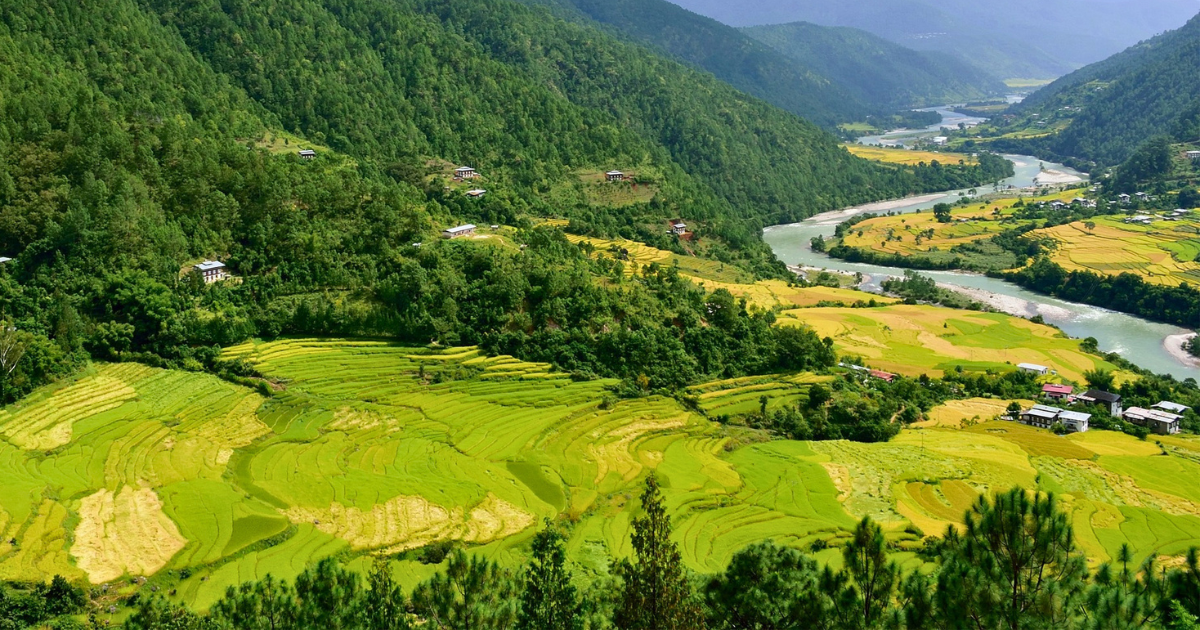
Eastern Bhutan's villages, dispersed across valleys just like this, are home to most of the country's finest weavers and natural dyers.
Why is weaving important in Bhutan?
Weaving is one of the thirteen traditional arts of Bhutan, known collectively as zorig chusum, and the craft itself is called thagzo. Each region has developed its own patterns, fibres, and techniques over generations. Knowledge has been passed down almost entirely by oral tradition, yet most of the motifs woven today trace back to designs used centuries ago.
Royal patronage has given the tradition further weight, particularly through Her Majesty the Queen Mother Ashi Sangay Choden Wangchuck, who founded the Royal Textile Academy in Thimphu and has championed Bhutanese weaving at home and abroad. Her work has helped protect the craft during a period when cheaper machine-made imitations from India have flooded regional markets, and has kept natural dyes and indigenous techniques at the centre of the national story.
Where is Khaling village located in Bhutan?
Khaling village, Bhutan's most established eastern weaving centre, sits in the southern reaches of Trashigang Dzongkhag, on the highway that runs between Trashigang town and Samdrup Jongkhar on the Indian border. The village lies at around 2,000 metres, in a landscape of forested ridges and terraced fields, and is reached by a long but scenic drive from either direction.
Daily life in Khaling revolves around farming, family, and the loom. Maize, potatoes, and vegetables grow on the slopes above the village, and the settlement sits on the natural route for travellers heading deeper into eastern Bhutan crafts country, within easy reach of Radhi and the kishuthara villages of Lhuentse beyond.
What is Khaling known for?
Khaling's name is closely tied to the National Handloom Development Centre, which has made the village one of the most celebrated weaving addresses in the country. Beyond the centre itself, Khaling is admired for its mastery of natural dyes and raw silk, and for the beautiful textiles that leave the village each year for markets across Bhutan.
The National Handloom Development Centre
The centre sits about three kilometres outside the village and is proudly run by the National Women's Association of Bhutan. Its purpose is to train rural weavers, supply yarn on credit, and buy back the finished cloth for sale through the government handicraft emporiums in Thimphu, Paro, and Bumthang. The centre champions eastern Bhutanese weaving traditions, which gives it a distinct character from the wool-based work done further west in Bumthang.
Visitors are warmly welcomed to walk through the weaving halls, where women work at back strap and horizontal frame looms among the natural dye gardens and vats. Staff are happy to share the full story from cocoon to cloth, and prices reflect the time and skill invested by each weaver, offering wonderful value for anyone keen to bring home an authentic piece.
Natural dyeing and raw silk
Khaling is one of the places in Bhutan where natural dyeing continues to thrive at scale. The dyers work with indigo for blues, lac insect for reds, madder for deeper reds and oranges, and walnut and rhubarb for browns and golds. The colours are beautifully soft compared with synthetic dyes, and they age gracefully over years of wear, which is one reason naturally dyed kiras are so prized in Bhutanese markets.
Khaling also celebrates the sericulture traditions, where raw silk, known as bura, has been produced for generations. Cocoons are boiled, spun, and dyed on site, and the yarn is then woven using techniques shared across Trashigang and neighbouring districts. Few other places in Bhutan bring the land, the dye plants, the silkworms, and the weavers together quite so completely, and Khaling's handloom textiles carry that connection in every thread.
Textiles produced in Khaling
Textiles from Khaling are among the most carefully made in the country, and the range is broader and more exciting than many visitors expect. Weavers produce full kiras and ghos, alongside smaller items such as rachus (women's ceremonial shoulder cloths), kabneys (men's ceremonial scarves), table runners, and cushion covers. Patterns range from the crisp plain weaves worn every day to the more elaborate supplementary warp and weft designs reserved for festivals and formal occasions.
Naturally dyed raw silk pieces sit at the higher end of the range, with full kiras rewarding weeks or months of patient work. Simpler cotton and acrylic-blend items offer lovely options for travellers looking to take something home at a gentler price. Whichever piece a visitor chooses, it carries the signature of a named weaver and a direct link to the dye gardens and looms just metres away.
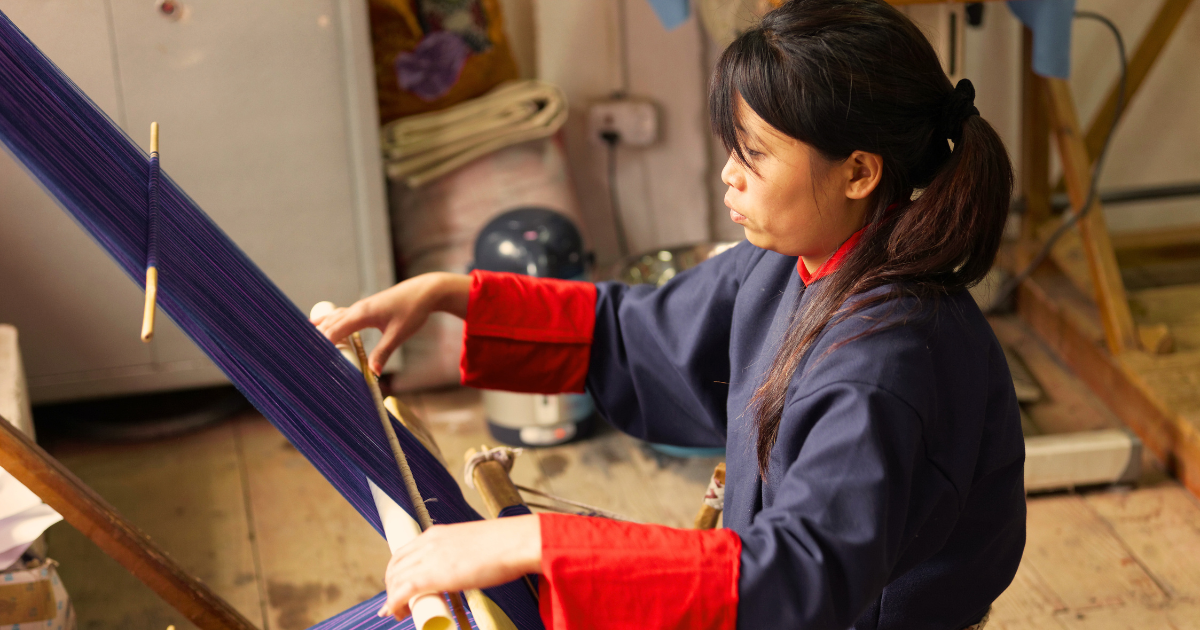
A complex piece can take weeks or even months to complete, with the most intricate kishuthara kiras requiring up to a year at the loom.
What textiles are made in Eastern Bhutan?
Eastern Bhutan is the country's textile heartland, and the weavers of Trashigang, Lhuentse, and the surrounding districts produce some of the most admired cloth in the kingdom. Cotton, raw silk, and fine silk form the foundation of the region's work, and each village tends to specialise in particular patterns and techniques that travellers can trace from loom to loom.
Kira and gho
The kira and gho sit at the centre of Bhutanese textile life, and most of the cloth woven in the east ends up as one or the other. The kira is a long rectangular wrap worn by women, fastened at the shoulders and belted at the waist, while the gho is the knee-length robe worn by men. Warp stripes run horizontally for women and vertically for men, which makes it possible to identify the weaver's intention from the first few centimetres of cloth on the loom.
Kishuthara
Kishuthara is the most celebrated textile in Bhutan, a richly patterned silk kira traditionally associated with the Kurtoe region of Lhuentse. It is woven on a backstrap loom using a technique called trima, in which coloured silk threads are coiled by hand around the warp to form raised motifs so fine they are often mistaken for embroidery. The patterns draw on Buddhist iconography and the natural world, and a complex piece can take up to a year to weave, with prices ranging from 30,000 to 75,000 BTN or roughly $430 AUD to $1,100 AUD and exceptional examples commanding more.
Bura, aikapur, and mentsi mathra
Alongside kishuthara, eastern Bhutan is known for a family of warp-patterned textiles that show off the region's skill in a quieter register, including bura, the raw silk of Trashigang most closely associated with Radhi village and long linked to rank and ceremonial dress. Aikapur features a distinctive cross-hatch warp pattern woven using the hor technique, while mentsi mathra adds alternate yellow warp bands on a plain-woven red ground, and together with kishuthara these textiles form the core of eastern Bhutan crafts.
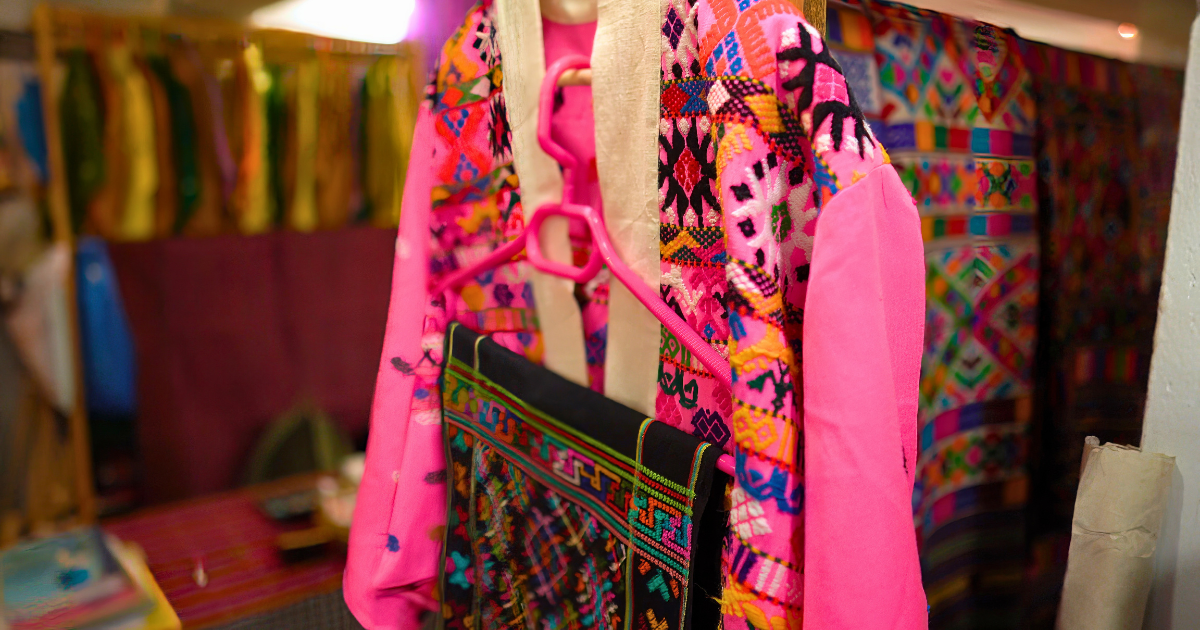
Each finished piece carries the signature of a named weaver and reflects the patterns and dyes specific to her region.
Where can you see weaving in Bhutan?
Weaving can be seen across the country, but the richest experiences are found in the east, where the craft is still woven into daily life. A well-planned journey can take in the key centres in a single trip, moving from the capital's institutional collections to the villages where the cloth is actually made.
Khaling and the National Handloom Development Centre
Khaling is the most accessible working weaving village for travellers heading east, and the National Handloom Development Centre offers the clearest window onto the full process from dye plant to finished cloth. Visitors can watch weavers at the looms, see the natural dye vats and gardens, and buy directly from the source.
Radhi Village, Trashigang
Radhi sits about an hour's drive from Trashigang town, surrounded by terraced rice fields and known across Bhutan as the home of bura, the raw silk woven into some of the country's finest ceremonial cloth. The looms here are mostly at home, and a visit usually means being welcomed into a weaver's porch or courtyard to watch her at work.
Khoma and Kurtoe, Lhuentse
Khoma is the heart of Kishuthara country, where more than eighty per cent of the women weave for a living and the village comes alive with the sound of the looms between harvest and planting. A visit here offers a rare chance to see the trima technique practised at the highest level, often under bamboo shelters set among the harvested fields.
The Royal Textile Academy, Thimphu
For travellers with limited time, the Royal Textile Academy in Thimphu is the best introduction to Bhutanese weaving, with collections that span the country's major traditions and regular demonstrations by master weavers. It is a useful orientation before heading east, and a worthwhile stop in its own right for anyone interested in the story behind the cloth.
How is Khaling weaving different from Lhuentse weaving?
The clearest difference lies in what each place is best known for producing. Lhuentse, and particularly the villages of Khoma and Kurtoe, is the home of Kishuthara and the ancestral district of the Wangchuck royal family. Khaling, by contrast, is the training and natural-dye hub of the east, with the National Handloom Development Centre focused on raw silk, cotton, and preserving the indigenous dye practices that once defined Bhutanese weaving more widely.
Technique and output also set the two apart. Lhuentse's weavers work almost exclusively with the demanding trima method to create the raised motifs that define kishuthara, while Khaling's looms produce a broader range of plain weaves, warp-patterned cloth, and supplementary weft designs at varying levels of complexity and price. A traveller interested in seeing the very finest silk brocade work will head to Khoma, while those drawn to the full cycle of dye, yarn, and loom under one roof will find Khaling the more rewarding stop. Visiting both gives the clearest picture of Bhutan weaving east of the Pele La.
Can you visit weaving villages in Bhutan?
Yes, weaving villages are open to travellers, and a visit is one of the most rewarding ways to understand eastern Bhutan. With a little planning around access and timing, the villages of Khaling, Radhi, and Khoma can all be worked into a single journey through the east.
How do you get to eastern Bhutan?
All international visitors travel with a licensed Bhutanese guide and pay the Sustainable Development Fee, and weaving villages are routinely included on custom made itineraries through the east. Most travellers fly into Paro and drive east through Bumthang and Mongar, which is a journey of several days each way, though the southern route via Samdrup Jongkhar offers a shorter approach to Khaling and Trashigang for those crossing from India.
When is the best time to visit Khaling?
The best months to travel are October to November and March to April, when the weather is settled and the skies are clear. The weavers are also most active in the winter months between harvest and planting, so visits from late autumn onwards often catch the looms at their busiest.
What can you expect on a village visit?
A village visit usually combines loom demonstrations, time in the dye gardens at Khaling, and conversations with the weavers themselves. There is also the chance to buy directly from the women who made the cloth, which is the most meaningful way to support the craft and take home a piece with a clear story.
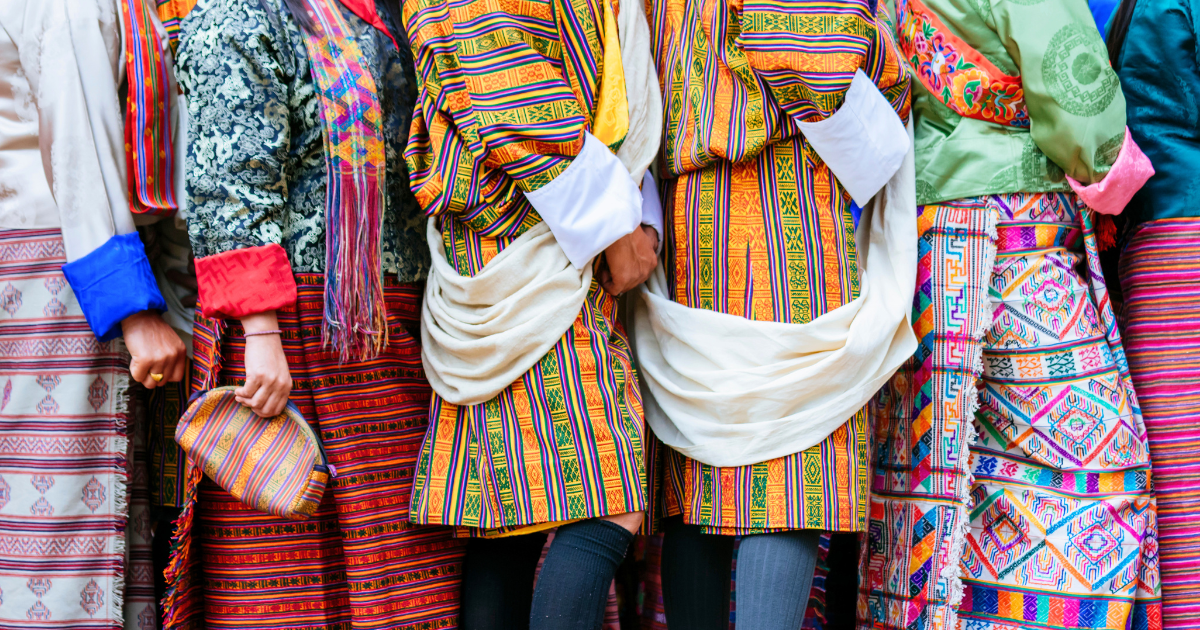
Warp stripes run vertically for men and horizontally for women, identifying the wearer's gender from across a courtyard.
Travel to eastern Bhutan with Asia Unbound
Asia Unbound designs private journeys that reach well beyond the usual Paro and Thimphu circuit, and Bhutan's east is one of the regions we know best. A Bhutan private tour can be custom-made to include Khaling, Radhi, and Khoma as part of a longer journey through the country, with expert local guides who know the weavers, the dye gardens, and the quiet routes between them.
Travellers stay in carefully chosen accommodation along the way, and the pace allows time for the kind of slow, informed encounters that make the east worth the distance. If you would like to include the weaving villages of eastern Bhutan in a private journey, contact us to start planning.