
A Guide To Birdwatching In Chitwan National Park For Twitchers
Nepal is known first for the Himalaya, but the south of the country is a different world. Along the border with India runs the Terai, a belt of flat, low land that was once unbroken jungle and floodplain. This is the warm, subtropical side of Nepal, where rivers drain off the mountains and feed the grasslands and sal forests that still cover much of the region. Chitwan lies at the centre of it, in a wide valley where the Rapti and Narayani rivers meet.
Chitwan National Park covers close to 950 square kilometres of this country, holding riverine forest, tall grassland, oxbow lakes and slow-moving water often within a short distance of each other. Most travellers come for the tigers, rhinos and gharials, which are what the park is best known for, but the same mix of habitats that suits those animals also makes Chitwan one of the best places to watch birds in South Asia. Even the forest tracks and grassland edges turn up birds easily, with Indian peafowl among the most common and visible throughout the park.
Birding in the Nepal Terai usually begins at Chitwan. Its bird list runs into the hundreds and covers grassland species, large waterbirds, forest hornbills and the migrants that fly in from Central Asia each winter.
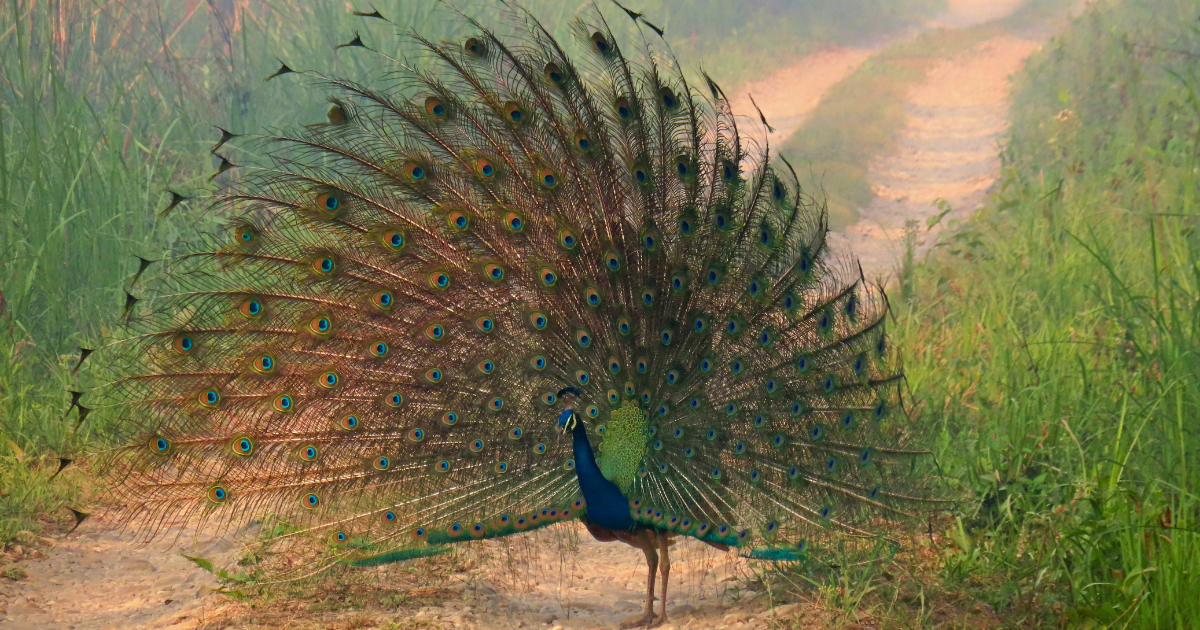
The Indian peafowl is one of the most commonly seen birds in Chitwan, often spotted on forest tracks and grassland edges throughout the park.
Is Chitwan good for birdwatching?
Chitwan is the most established birding site in Nepal and one of the better-known parks for birds in South Asia. Around 544 species have been recorded inside the park, and a visitor spending a full day in the right habitats can reasonably expect to see between 100 and 150 of them.
What sets Chitwan apart is the range of habitats held in a small area. Sal forest, tall floodplain grassland, rivers and marshland all sit close together, and each supports a different set of birds. A birder can move between them in the course of a single morning, which is why the park rewards even a short visit and why it remains the natural starting point for the birds of Nepal.
How many bird species are in Chitwan?
Around 544 species have been recorded in Chitwan, the figure used by the park authority and most birding sources. Nepal's official national checklist holds 886 species, so a single park in the lowlands accounts for well over half the birds recorded across the whole country, including its mountains and mid-hills.
The number shifts a little depending on the source, and lists that include rare one-off sightings put it closer to 650. More than 20 of Chitwan's birds are globally threatened, including the Bengal florican, the lesser adjutant and several vultures that have become scarce across the region.
Most of these are resident birds that stay year-round, but a good share are winter migrants that arrive between October and March and push the numbers up. A full day in a mixed habitat will often turn up 100 to 150 species, and a week of careful birding can pass 200.
What birds can you see in Chitwan?
Chitwan's birds sort naturally by habitat, and the range on offer is what makes the park so rewarding. The grasslands, rivers, marshes and forest each hold their own species, and a birder moving between them in a single morning can build a remarkable list.
The Bengal florican and the grassland birds
The Bengal florican is the bird most serious birders come to Chitwan hoping to see. It is a bustard, roughly the size of a large chicken but longer in the leg and neck, and one of the rarest birds in the world. Fewer than a few hundred survive in the whole of South Asia, scattered across remnant grasslands in India and Nepal, which makes Chitwan one of the few places it can still be found.
The male Bengal florican is mostly black, with a buff-brown back and bold white wing patches that flash when it flies. For most of the year it stays hidden in tall grass and is very hard to see. In the breeding season, from around March, the male gives itself away with a leaping display flight, springing straight up above the grass with wings beating to attract a mate. It is among the most sought-after sights in Asian birding.
The same grasslands hold other birds that are easier to find but still uncommon. The swamp francolin is a heavy, rufous-brown gamebird that calls loudly at dawn. Skulking species such as the slaty-breasted rail and a range of warblers live low in the grass and are heard more often than seen. These are birds that reward patience and a guide who knows where to look.
The lesser adjutant and Chitwan storks
The lesser adjutant is a large stork, standing well over a metre tall, with a bare yellowish head and neck and a heavy wedge-shaped bill. It is one of the threatened species the park is known for, and it is often seen stalking the edges of marshes and wet fields. The bare head is an adaptation shared with vultures, suiting a bird that feeds partly on carrion as well as fish, frogs and large insects. In flight it carries its neck tucked back rather than outstretched, which separates it from the cranes that share the same wetlands.
Chitwan supports several other storks alongside it. The woolly-necked stork is easily told by its white neck and dark body, and is usually seen alone or in pairs on damp ground. The Asian openbill is a smaller stork named for the permanent gap left between the two halves of its closed bill, a shape it uses to grip and open the large water snails it feeds on. Painted storks, with their pink-tinged wings, also appear at times, adding to the variety on the park's open water.
The wetlands hold a good range of smaller waterbirds too. The bronze-winged jacana walks across floating vegetation on very long toes that spread its weight over lily pads and matted weed. The cotton pygmy goose, one of the smallest wildfowl in the world, gathers on quiet pools, while great egrets, grey herons and glossy ibises work the shallows alongside them. Together these birds make the park's lakes and marshes some of the most productive birding of any visit.
Pallas's fish eagle and the river species
Pallas's fish eagle is the signature bird of Chitwan's rivers. It is a large brown eagle with a pale head and a broad white band across the tail, usually seen perched in a tall tree near water or carrying a fish in its talons. It is a threatened species in steady decline across its range, so a clear sighting is something to note. The smaller grey-headed fish eagle hunts the same waters and is more often heard than seen, giving a loud nasal call from the riverside forest.
The rivers and their sandbanks support a distinctive set of birds beyond the eagles. River lapwings and great thick-knees rest on the open shingle, well camouflaged against the stones until they move. Small waders such as little ringed plovers run along the water's edge, and terns work the channels above, dipping to the surface to feed. These are birds of the open river rather than the forest, and they are easiest to find where the water runs wide and shallow.
Kingfishers are a particular feature of the rivers. They range from the small common kingfisher, a darting flash of blue, up to the large stork-billed kingfisher with its heavy red bill, with the black-and-white pied kingfisher hovering over the water before diving for fish. A boat trip along the Rapti often brings several kingfisher species in a single stretch, which is one of the reasons river birding here is so rewarding.
The great hornbill and the sal forest birds
The great hornbill is the most striking bird of Chitwan's forest. It is very large, with black-and-white plumage and a tall yellow casque sitting on top of its bill, and its heavy wingbeats can be heard from a distance as it flies between fruiting trees. The smaller oriental pied hornbill is more common and travels in noisy groups, feeding on figs and other fruit. Both depend on mature forest with large old trees for nesting, which makes the park's sal woodland important for them.
Hornbills have an unusual nesting habit worth knowing about. The female seals herself into a tree hollow behind a wall of mud, leaving only a narrow slit through which the male passes food while she incubates and the chicks grow. This ties the birds closely to undisturbed old-growth forest, and their presence is a sign of forest in good condition. Watching a hornbill arrive at a fruiting tree is one of the more memorable moments of forest birding in Chitwan.
The forest holds many other birds worth the effort. Woodpeckers such as the greater flameback work the tree trunks, the red-headed trogon sits quietly in the mid-storey waiting for insects, and the common hill myna, a glossy black bird with bright yellow wattles, calls loudly from the canopy. Forest birding is slower work than open country and the birds are often hidden in foliage, but the variety is high for those willing to walk and watch.
Common teal, pintail and the winter migrants
From October the resident birds are joined by large numbers of migrants escaping the winter further north in Central Asia, Siberia and Tibet. The Terai lowlands sit along a natural route for these birds as they move south ahead of the cold, and Chitwan's wetlands give them somewhere to rest and feed. This seasonal influx is what makes the cooler months the busiest time of year for birding in the park.
Ducks make up much of the arrival. The common teal, a small fast-flying duck, and the northern pintail, named for the male's long tail feathers, gather on the lakes and slower river stretches in good numbers, along with the rust-coloured ruddy shelduck. On a good winter morning the park's open water can hold several hundred ducks of mixed species, a very different scene from the same lakes in summer.
The migration brings birds of prey and waders too. The greater spotted eagle, a large dark raptor, hunts the wetlands through the cooler months, and a range of sandpipers and other waders feed along the muddy margins. These winter visitors are the main reason the park's bird list climbs so sharply between October and March, and why the timing of a visit makes such a difference.
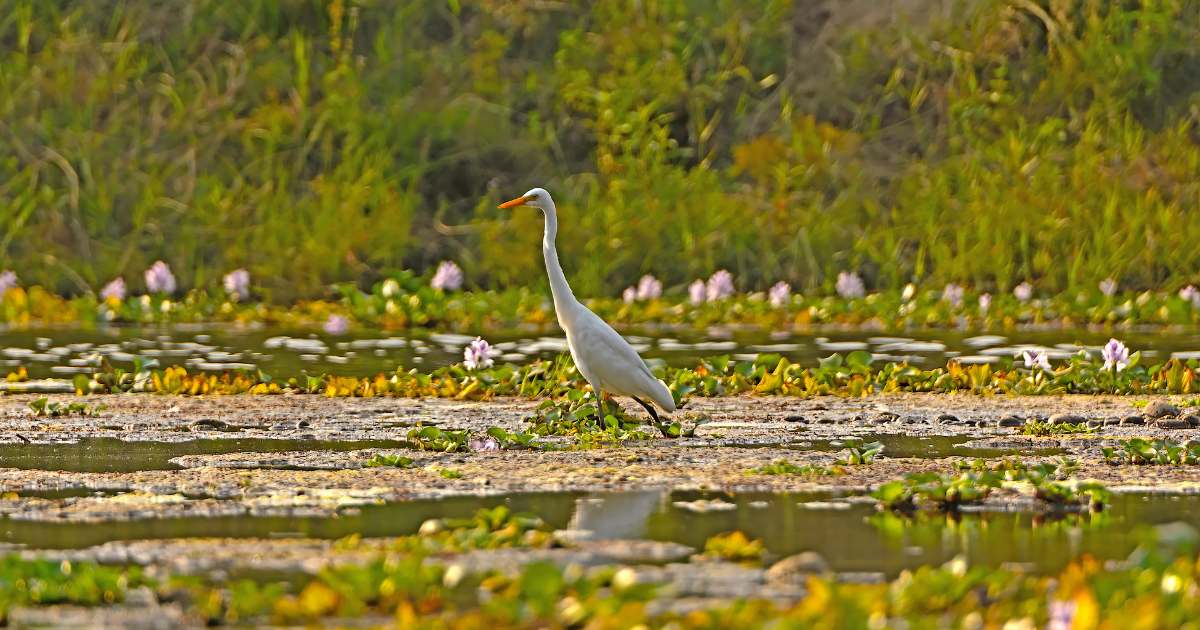
Chitwan's oxbow lakes and marshes support large numbers of waterbirds year-round, with the count rising sharply as winter migrants arrive.
The best spots for birdwatching in Chitwan
Chitwan covers a lot of ground, and its birds shift with the habitat. Each part of the park favours a different set of species, depending on whether it holds forest, grassland or water. Where the birding time is spent makes the difference between a long list and a thin one, and most visits combine two or three of the areas below.
Sauraha and the eastern buffer zone
Sauraha is the main entry point to Chitwan and the base for most birding visits. The village sits on the edge of the park beside the Rapti River, with lodges, guides and transport all close at hand. Even before entering the park proper, the surrounding farmland, riverbank and community forest hold a good range of birds, and an early walk near the lodges often turns up parakeets, barbets, bee-eaters and a variety of smaller species.
The community forests around Sauraha are managed by local people and have become productive birding grounds in their own right. They are quieter than the park interior and are laced with walking trails and the occasional watchtower, which gives a clear view into the canopy where many forest birds feed. Owls and nightjars are often found here after dark. For a first morning in Chitwan, the eastern buffer zone is the easiest place to start.
Bishazari Tal (Twenty Thousand Lakes)
Bishazari Tal is the most important wetland in the Chitwan area and one of its best birding sites. It is a large system of oxbow lakes covering around 32 square kilometres in the park's buffer zone, and it is recognised internationally as a Ramsar wetland of importance for waterbirds. The name translates as Twenty Thousand Lakes, a nod to the maze of connected pools and channels that make up the site.
The still water draws ducks, herons, egrets, storks and kingfishers, and the numbers climb through the winter as migrants arrive. Early morning is the time to be here, when the water is calm and birds are active around the margins. The site is reached on foot or by jeep from Sauraha, and a quiet approach pays off, since many of the waterbirds are easily put to flight.
The Rapti River corridor
The Rapti runs along the northern edge of the park and is one of the most rewarding stretches for birding, partly because of how it is travelled. The classic approach is a dawn float in a dugout canoe, drifting downstream past sandbanks, overhanging trees and basking gharials with little noise to disturb the birds, and many trips continue toward the Bishazari Tal wetlands to link two of the best sites in a single morning.
From the water, kingfishers, river lapwings, great thick-knees resting on the shingle and terns working the channels are all regular sightings, while Pallas's fish eagle and the grey-headed fish eagle both hunt this stretch and the riverside trees often hold perched raptors. The slow pace of a canoe, low to the surface, makes this one of the better ways to see river species well.
The Narayani River and western sector
The Narayani is the larger river system on the park's western side, near the village of Meghauli. This part of Chitwan sees far fewer visitors than Sauraha and feels more remote, with tall riverine forest along the banks. Birders who make the effort to come here are rewarded with quieter conditions and a slightly different mix of species, including good numbers of larger waterbirds along the river.
The western riverine forest is particularly good for hornbills. All three of the park's hornbills, the great hornbill, the oriental pied hornbill and the Indian grey hornbill, nest in the tall old trees here, and the area is among the more reliable places to see all three. Bee-eaters, falconets and owls are also recorded along this stretch, which makes the western sector well worth the extra travel for a serious birding visit.
Sal forest interior tracks
The core of the park is covered in mature sal forest, and the tracks running through it give access to Chitwan's true forest birds. This is slower birding than the open river or wetland, with birds often high in the canopy or hidden in foliage, and it usually means a jeep with a licensed guide.
Woodpeckers, the red-headed trogon, hill mynas and various pigeons and barbets all live in the forest interior, along with the hornbills moving between fruiting trees. Brown fish owl and brown hawk owl roost in the denser stands. Forest birding takes more effort than the rest of the park, but it is the only way to catch its full range of species.
Tiger Tops and the western grasslands
The far west of the park, around the long-established Tiger Tops area, holds some of the best remaining grassland in Chitwan. These tall floodplain grasslands are the habitat of the park's rarest birds, and they are the place to look for the Bengal florican, particularly in the breeding season when the male performs its leaping display above the grass at dawn.
The grasslands also hold the swamp francolin, various harriers quartering low over the grass in winter, and skulking warblers and rails that take patience to see. Access is more limited than in the eastern park, and the grass is at its most workable after the annual cutting and burning in the dry season. For grassland specialists, though, this is the part of Chitwan that matters most.
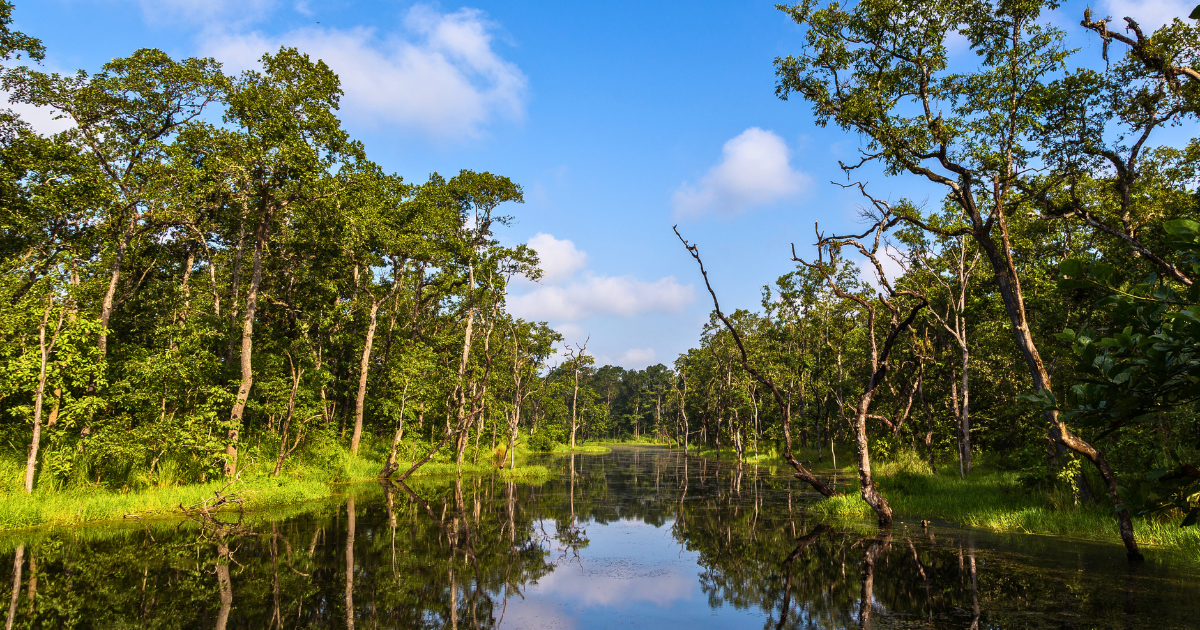
Sal forest covers roughly 70 percent of Chitwan and supports hornbills, woodpeckers, trogons and other species found nowhere else in the park.
What you need to know before birdwatching in Chitwan
Good birding in Chitwan depends as much on planning as on luck. The season, the choice of guide and the way each day is run all affect what turns up, and a little preparation makes the most of the time in the park.
When is the best time for birdwatching in Chitwan?
The main birding season runs from October to March. These are the cooler, drier months, when the resident birds are joined by large numbers of migrants and conditions for walking and watching are at their best. Mornings can be cold and misty in December and January, but the mist usually clears by mid-morning and the volume of birds more than makes up for the early chill.
February to April is often the most productive period of all. The tall grasses are cut and burned through the dry season, opening up the grasslands that are otherwise impossible to see into, and this is the easiest time to find the Bengal florican and other grassland birds. It also overlaps with the start of the florican's breeding display.
Do you need a guide for birdwatching in Chitwan?
A licensed guide is required for all activities inside Chitwan National Park, so going in alone is not an option. Every jeep safari, canoe trip and walk is accompanied by a trained naturalist, both for safety in a park that holds rhinos, tigers and sloth bears, and to meet park rules. The mandatory guide is usually included in the cost of a safari programme or arranged through a lodge.
For birding, the type of guide matters. A general park guide knows the animals and the safety routine but may be limited on birds, while a dedicated birding guide can identify species by call, knows where particular birds are likely to be and understands how to approach them quietly. For a trip focused on birds, it is worth asking for a specialist in advance rather than relying on whoever is assigned on the day.
How to get to Chitwan
Most visitors reach Chitwan from Kathmandu or Pokhara. The road journey takes roughly five to seven hours from either city, running down out of the hills and onto the flat Terai, and a private vehicle is the most comfortable option. The drive itself passes through a changing country and forms part of the experience.
For those short on time, a short flight from Kathmandu to Bharatpur takes about twenty minutes, followed by a drive of half an hour or so to the lodges around Sauraha. Bharatpur is the nearest airport to the park and the usual choice for travellers pairing Chitwan with other parts of Nepal who would prefer to save a day on the road.
What to bring for a day in the field
The essential item is a pair of binoculars, and a regional field guide to the birds of Nepal or the Indian subcontinent helps with identification in the field. A spotting scope is useful for the open wetlands and rivers, where birds are often seen at distance across the water, though a good guide will usually have one.
Clothing should be muted in colour, in greens and browns that do not stand out against the surroundings, since bright clothing can put birds to flight. Sturdy footwear suits the mixed walking on forest tracks and grassland, and sun protection matters in the open country and on the rivers. Mornings begin early, often before dawn, so warm layers are sensible in the winter months when the Terai can be cold at first light.
How to watch birds responsibly
Chitwan protects several threatened species, and a few simple habits help keep the birding low-impact. Keeping a sensible distance from nesting sites and from sensitive grassland birds matters most, particularly with the Bengal florican during its breeding display, when disturbance can drive birds off their territories. A quiet approach also produces better sightings, since most birds settle when left undisturbed.
Staying on the permitted tracks and waterways is both a park rule and good practice, and it is part of why guided access is required. The low-disturbance methods built into a Chitwan visit, such as drifting downriver by canoe, exist precisely because they let birders watch closely without putting birds to flight. Responsible birding here is largely a matter of patience and restraint, and it tends to be rewarded with better views.
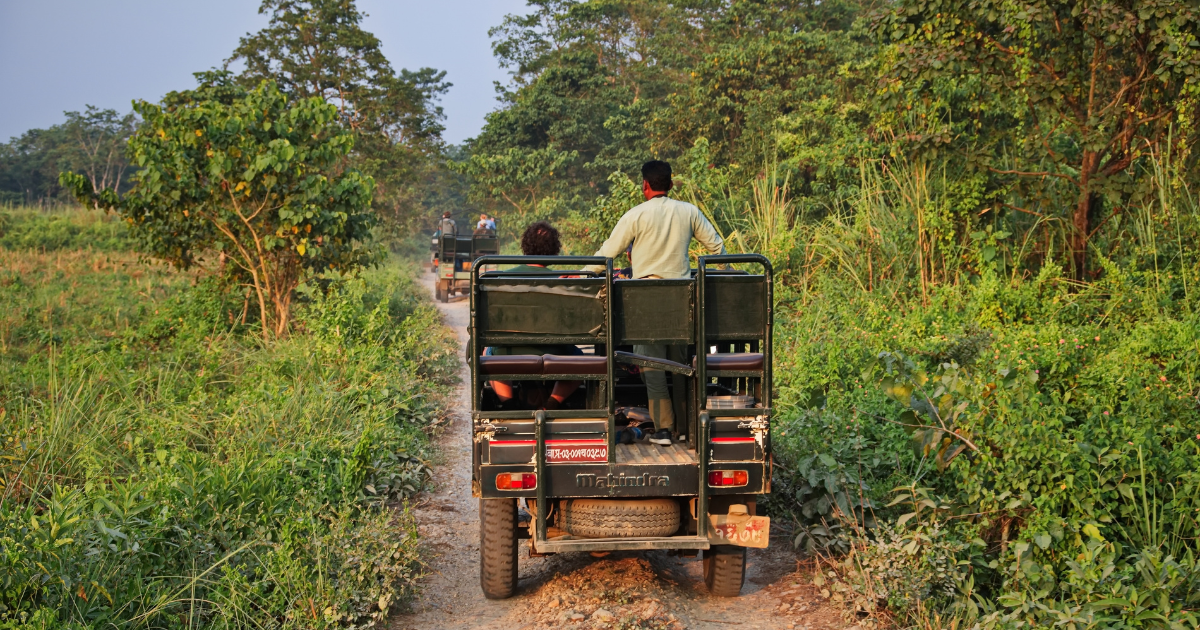
A licensed guide is required for all activities inside the park, and most birding in the forest interior and grasslands is done by jeep.
Birdwatching in Chitwan with Asia Unbound
Asia Unbound arranges private, custom-made tours of Nepal that can be built around birding for those who want it. Each journey is supported by expert local guides who know the regions and their birds, which makes a difference when looking for the rarer grassland and forest species the park is known for.
For travellers who want to go further, a Nepal birding tour can extend into the wider subcontinent, linking the Terai with the Himalaya, Northern India or Bhutan on a single trip. To start planning a journey to Chitwan and the birds of Nepal, contact our team to discuss the route, the timing and the travel that suits you.