
Exploring The Historic Capital Of Gyeongju
South Korea is often associated with Seoul and Busan, but its early history was centred in the south-east. The Silla Kingdom, one of three early Korean states, ruled this region from the 1st century BCE and unified the peninsula in 668 CE, holding power until 935. For close to a thousand years, it was the political and religious authority on the Korean Peninsula.
At the heart of the kingdom was Gyeongju, set among forested hills inland from the east coast and roughly halfway between Daegu and Busan. The city is small by Korean standards, with a compact centre and few of the high-rise developments common elsewhere in the country. Building heights are restricted across the historic areas to preserve sightlines over the royal tombs, palaces and temple ruins that remain visible throughout.
Gyeongju holds one of the densest concentrations of historic sites in East Asia, several protected under UNESCO, with many more in the surrounding countryside. For travellers interested in Korean history or Buddhist culture, a visit to the ancient capital provides direct access to the foundations of the country today.
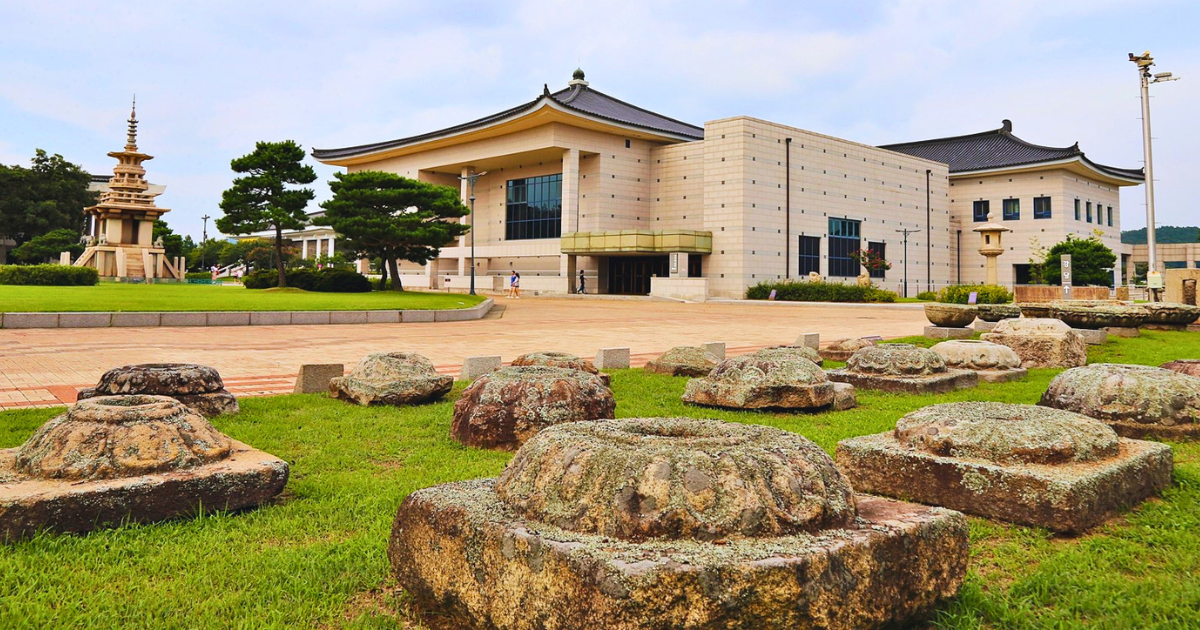
Gyeongju National Museum holds many of the artefacts recovered from the city’s royal tombs, palace ruins and temple sites.
What is the history of Gyeongju?
The history of Gyeongju is bound up with the Silla Kingdom, which ruled from the city for nearly a thousand years between 57 BCE and 935 CE. The city's name, footprint and most of its surviving heritage all date from that period, while its character today still reflects the long centuries that followed under successive Korean dynasties.
The founding of Saro and the rise of Silla
Gyeongju was first known as Saro, the seat of a confederation of villages that came together on the south-eastern plain in the 1st century BCE. Over the following centuries these villages gradually consolidated under a single ruling family and grew into the Silla Kingdom. The capital was later renamed Seorabeol, a name it held throughout most of Silla's reign.
The Three Kingdoms period
For nearly seven hundred years, Silla shared the peninsula with two larger neighbours, Goguryeo to the north and Baekje to the west, in a period known as the Three Kingdoms. The three states traded with one another and competed for influence, and Silla was initially the smallest and least powerful of the three. Its position began to change in the 6th century, when Buddhism arrived from China and was formally adopted as the state religion in 528 CE, bringing with it new architecture, art and an ideology that would draw heavily on royal patronage.
Unification and Silla's golden age
Silla's standing changed again in the mid-7th century, when it formed an alliance with Tang China. Baekje fell in 660 CE and Goguryeo eight years later, bringing most of the Korean Peninsula under a single Korean dynasty for the first time and ushering in the period known as Silla's golden age. Population estimates from the era suggest close to a million inhabitants, and trade routes connecting Tang China, Central Asia and the Japanese archipelago passed through the city, bringing goods, monks and artisans. Most of Gyeongju's defining sites were built during these centuries, including Bulguksa Temple and the nearby Seokguram Grotto in the 8th century.
The decline and fall of Silla
The decline began two hundred years later, as regional governors gained autonomy and central authority weakened. In 927 CE, the city was attacked by the rival Later Baekje kingdom and the Silla king died in the assault. A new ruler took the throne, and in 935 CE he peacefully ceded power to Wang Geon, who had founded the Goryeo Dynasty seventeen years earlier and established his capital at Gaegyeong, in modern-day Kaesong. Five years later, in 940, the former Silla capital was renamed Gyeongju.
Gyeongju after Silla
Under Goryeo and later Joseon, Gyeongju settled into life as a provincial town. Some sites were affected by the Mongol invasions of the 13th century and the Japanese invasions of the 1590s, and several structures, including Bulguksa, were rebuilt in the centuries that followed. Even so, enough of the original Silla city remained that in 2000 UNESCO inscribed the Gyeongju Historic Areas, formally recognising the surviving and reconstructed sites as cultural heritage of global significance.
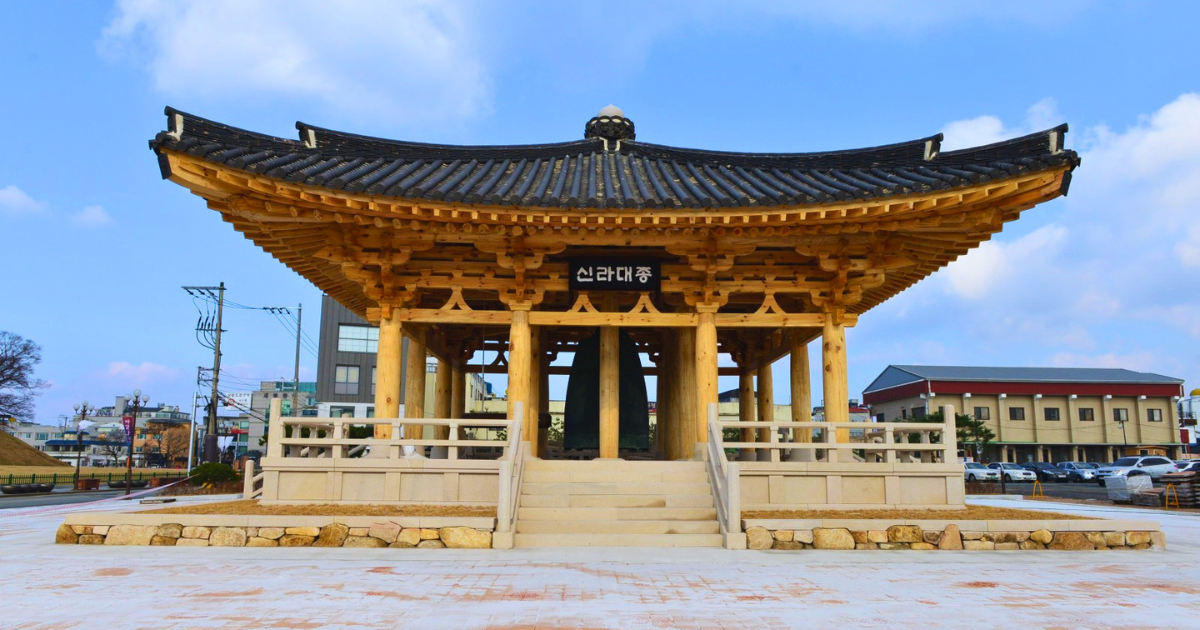
Gyeongju’s surviving tombs, temple sites, stone monuments and the Sacred Bell of King Seongdeok trace the rise of Silla from a regional kingdom to Korea’s first unified dynasty.
What is Gyeongju famous for?
Gyeongju is best known for the scale and visibility of its Silla heritage, from royal tombs and temple ruins to Buddhist monuments recognised by UNESCO. Its reputation rests on the visible Silla legacy across the city, the three UNESCO inscriptions that recognise that heritage, and its standing as one of Korea's leading cherry blossom destinations.
A heritage city in plain view
Most of Gyeongju's historic sites sit openly within the city rather than being grouped into a single archaeological zone. Royal tombs rise out of public parks in the centre of town, temple ruins line residential streets and stone pagodas stand among ordinary cafes, shops and homes. The city is often described as a museum without walls, a phrase that reflects how visible the Silla legacy is at street level. Even the central business district sits beside the Daereungwon tomb complex, with the burial mounds visible from the main shopping streets.
Three UNESCO World Heritage listings
Three separate UNESCO World Heritage listings cover Gyeongju's historic assets. Bulguksa Temple and the nearby Seokguram Grotto were inscribed in 1995 as the country's leading examples of Silla Buddhist architecture and stone carving. The Gyeongju Historic Areas, inscribed in 2000, cover five separate site clusters across the city, including the royal tombs, the ruins of Hwangnyongsa Temple and the area around Mount Namsan. The nearby Yangdong Folk Village, listed in 2010, preserves a Joseon-era Confucian community that sits within the wider Gyeongju area.
What are the most famous historic sites in Gyeongju?
The main sites cluster around the Wolseong area, while Bulguksa Temple and the Seokguram Grotto sit farther east on the slopes of Mount Toham. The royal tombs, palace ruins and the city's astronomical observatory cluster around the central Wolseong area, while the national museum sits at its eastern edge holding most of the artefacts recovered from these sites.
The royal tombs of Daereungwon
Daereungwon is a walled park in the centre of Gyeongju that holds 23 grass-covered burial mounds from the Silla royal family. The tombs were raised between the 4th and 6th centuries CE for kings, queens and nobility, and some reach twelve metres in height. Excavations through the 20th century uncovered gold crowns, belts, jewellery and ceremonial weapons within many of the mounds, much of which now sits in the Gyeongju National Museum. One tomb, Cheonmachong or the Heavenly Horse Tomb, has been opened so visitors can walk into the burial chamber and see how the structure was built.
Bulguksa Temple
Bulguksa is the country's best-known Buddhist temple, inscribed in 1995 as one of the first South Korean sites on the UNESCO World Heritage list. It sits on the lower slopes of Mount Toham, about 16 kilometres east of central Gyeongju. The temple was built to its current scale in 774 CE during the Unified Silla period, on the foundations of an earlier structure from the reign of King Beopheung. The wooden halls were destroyed during the Japanese invasions of the 1590s and rebuilt in the 1960s and 1970s, while two original stone pagodas in the main courtyard, the Dabotap and the Seokgatap, have remained in place since the 8th century.
The Seokguram Grotto
The Seokguram Grotto sits higher up Mount Toham, accessed by a separate road that climbs above Bulguksa. It was carved out in the 8th century as an artificial stone chamber to house a 3.5-metre granite Buddha that faces east toward the sea. Inside, the walls are lined with carved bodhisattvas or guardian figures and disciples, sculpted in high relief in the 8th century. The interior is now sealed behind glass to control humidity, so visitors view the Buddha from a small antechamber rather than entering the chamber itself.
Cheomseongdae Observatory
Cheomseongdae is a 9-metre bottle-shaped tower of cut granite blocks built in the 7th century during the reign of Queen Seondeok. It sits in an open field near the Wolseong palace area and is the oldest surviving astronomical observatory in East Asia, though its exact function and how observations were made are still debated by scholars. Some elements suggest a ceremonial or calendar role alongside any astronomical use. The tower has been designated a national treasure of Korea and is among the easier sites to reach on foot from central Gyeongju.
Gyeongju National Museum
The Gyeongju National Museum sits on the eastern edge of the central historic area and holds the country's largest collection of Silla artefacts, much of it recovered from the city's burial mounds, palace ruins and temple sites. The collection includes the gold crowns excavated from the royal tombs, the bronze Sacred Bell of King Seongdeok cast in 771 CE, and stone Buddha figures from the hills around Mount Namsan. Several halls cover Silla history, Buddhist art and recent archaeological work, and the outdoor sculpture park can be visited without a ticket.
Donggung Palace and Wolji Pond
Donggung Palace and Wolji Pond sit a short walk from Cheomseongdae. The complex was completed in 674 CE during the reign of King Munmu as a secondary royal residence, with an artificial pond fed by a nearby stream and three small islands within it. The palace was used for state banquets and the reception of foreign envoys, and the original wooden buildings disappeared over the centuries. What stands today is a partial reconstruction of three pavilions on the pond's edge, most often visited after sunset when the buildings are illuminated and reflected in the water.
Mount Namsan
Mount Namsan rises directly south of the city centre and was treated as a holy mountain by the Silla court, used for Buddhist practice and royal pilgrimage. The slopes hold the ruins of 122 temples, 53 stone statues, 64 stone pagodas and 16 stone lanterns, most of them dating from the Silla period. Marked walking trails connect groupings of rock-cut Buddhas, relief carvings and pagoda ruins, allowing visitors to combine a half-day or full-day hike with a circuit of Silla-era sites. The Mount Namsan Belt forms one of the five components of the Gyeongju Historic Areas UNESCO listing inscribed in 2000.
Hwangnyongsa and Bunhwangsa
The Hwangnyongsa Temple Site holds the remains of what was once the largest Buddhist temple ever built in Korea, completed in 645 CE under Queen Seondeok and covering more than 72,000 square metres. Its 80-metre nine-storey wooden pagoda was destroyed during the Mongol invasions of the 13th century, and only the foundation stones remain on what is now an open archaeological field. Bunhwangsa Temple sits next to the site and remains active as a working Buddhist temple, with a stone pagoda completed in 634 CE under the same queen and considered one of the oldest in Korea.
Yangdong Folk Village
Yangdong Folk Village sits about 30km north-east of central Gyeongju and preserves one of Korea's most intact examples of a Joseon-era Confucian clan village. The village was settled in the 15th century by the Wolseong Son and Yeogang Yi families and remains inhabited today, with around 150 traditional tile-roofed and thatched houses spread across a hillside above farmland. Several of the houses are open to the public, along with a Confucian academy and a shrine, and visitors can walk freely through the lanes.
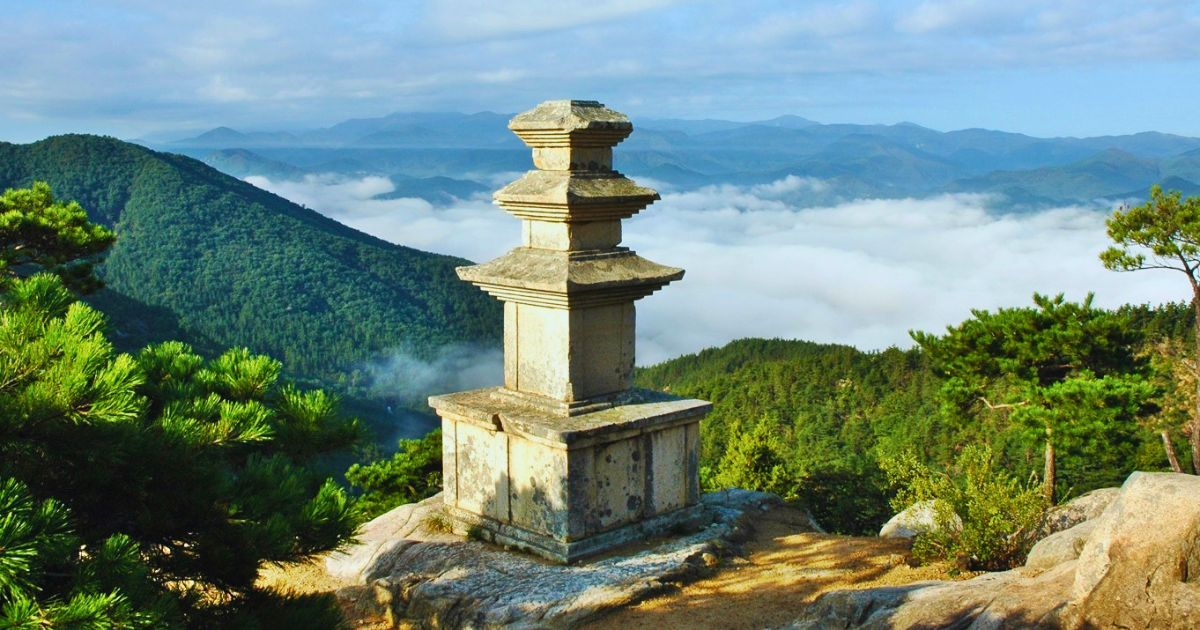
Mount Namsan is part of the UNESCO-listed Gyeongju Historic Areas, with Buddhist relics, temple remains and stone pagodas spread across its slopes.
Is Gyeongju worth visiting?
Gyeongju is one of Korea's central cultural cities and a recommended stop on most heritage-focused itineraries through the country. No other city on the peninsula holds the same concentration of pre-Joseon sites within walking distance of one another, and the surviving Silla material does not appear elsewhere. Outside the cherry blossom season the city is markedly quieter than Seoul or Busan, with a slower pace of sightseeing that suits travellers who prefer to take their time at each site.
Most travellers find Gyeongju engaging, particularly those with an interest in Korean history, Buddhist architecture, archaeology or early East Asian culture. For visitors more drawn to modern Korean life, including contemporary food, art and shopping, Gyeongju works best as a complement to Seoul or Busan rather than a substitute. For a Korea itinerary built around history and slower sightseeing, Gyeongju is the country's central heritage destination and one of the clearest places to understand Korea’s ancient capital.
What to know before visiting Gyeongju
Gyeongju is well set up for foreign travellers, with bilingual signage at the major sites and central distances short enough to manage without a private guide. Most paid sites open from 9am to 6pm, with longer summer hours and evening illumination at Donggung Palace and Wolji Pond until about 10pm. The Gyeongju National Museum closes on Mondays, so it’s good to check before planning a one-day visit.
Can you enter the royal tombs at Daereungwon?
Most of the 23 burial mounds at Daereungwon are sealed and cannot be entered, in line with Korean heritage preservation policy. The exception is Cheonmachong, or the Heavenly Horse Tomb, which was opened to the public after its 1973 excavation produced one of the best-preserved Silla tomb interiors on record.
A short corridor inside Cheonmachong leads to a small chamber where visitors can see a recreated cross-section of the burial structure and replica artefacts, including the painted saddle flap that gave the tomb its name. The remaining mounds can be viewed from outside as part of the walking circuit through the park.
How do you get between Gyeongju's main sites?
The central historic area is compact and best covered on foot or by bicycle. Rental shops near the bus terminal and around Hwangnidan-gil charge around 5,000 to 10,000 won (roughly $5 AUD to $10 AUD) for a half-day, and the area is flat and well suited to riding between the tomb park, Cheomseongdae, Donggung Palace and the national museum.
For longer trips, taxis are widely available and relatively inexpensive, and the most direct way to reach Bulguksa Temple and the Seokguram Grotto on Mount Toham. Local buses also serve all the main sites, with routes 10 and 11 connecting central Gyeongju to Bulguksa and bus 12 running between Bulguksa and the Seokguram Grotto, though waiting times can run 20 to 30 minutes between services.
How much are the entrance fees for the historic sites?
Many of Gyeongju's headline sites are now free to enter. Bulguksa Temple and the Seokguram Grotto have had no admission charge since May 2023, when the Korean government abolished entrance fees at major Buddhist temples, and the Gyeongju National Museum and Cheomseongdae are also free.
The main paid sites are Daereungwon and Donggung Palace with Wolji Pond, which both charge around 3,000 won (roughly $3 AUD) for adult entry. The Yangdong Folk Village outside the city has a separate admission of about 4,000 won (around $4 AUD), and the Gyeongbuk Tour Pass for foreign visitors covers many of these attractions on a single ticket.
Where should you stay in Gyeongju?
Most travellers stay in the central historic area, where hotels, guesthouses and small hanok or traditional Korean house stays sit within walking distance of Daereungwon, Cheomseongdae and the main shopping streets. This is the most convenient base for two or three days in the city, with restaurants, cafes and transport close by.
The alternative is the Bomun Lake area, about 5km east of the centre, which has several larger international hotels and resorts arranged around an artificial lake. It is quieter than the centre and suits travellers who prefer hotel amenities, though it requires a taxi or bus to reach the main historic sites each day.
How many days should you spend in Gyeongju?
Most travellers spend two to three days in Gyeongju, which works well for a balanced Gyeongju itinerary covering the city's main sites without rushing. Two days is enough for the central historic area, the royal tombs, Bulguksa Temple and the Seokguram Grotto, and the national museum. A third day allows for a slower pace, time on Mount Namsan and the surrounding hills, and a visit to the Yangdong Folk Village outside the city.
For travellers with less time, a single day is possible as a Gyeongju day trip from Busan, particularly when focused only on the headline sites. With an early start, it is feasible to see Bulguksa, the Seokguram Grotto, the Daereungwon tomb park and Cheomseongdae in one day, though each visit will be brief. Returning to Busan in the evening is also straightforward by train or bus.
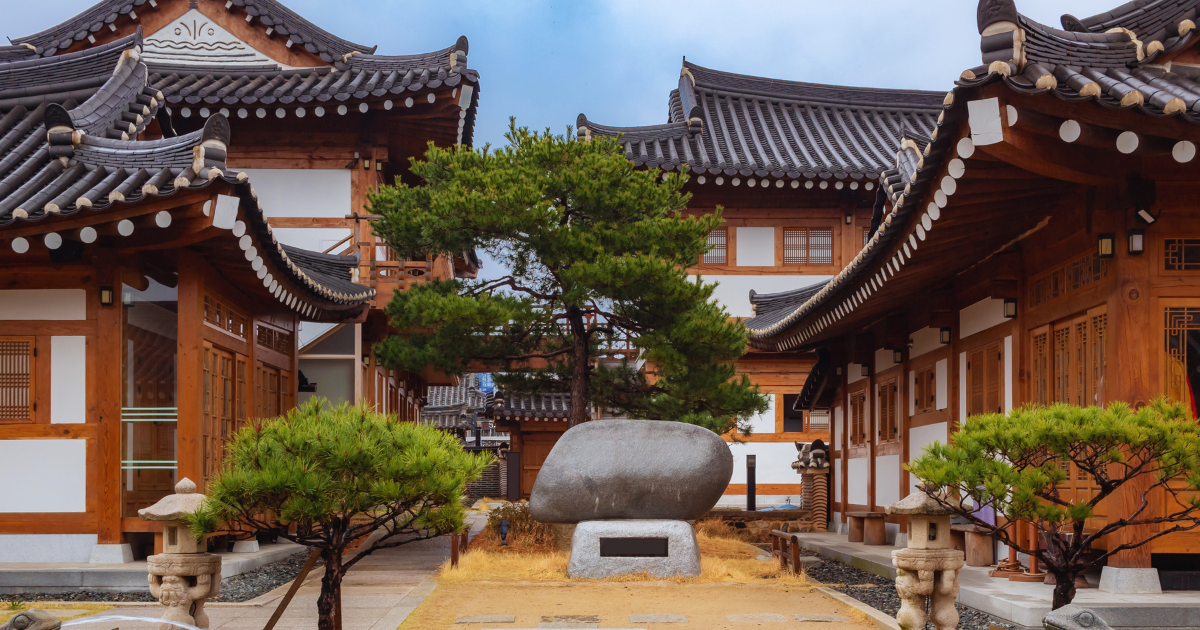
Central Gyeongju has hotels, guesthouses and hanok stays within easy reach of the main historic sites.
How to get to Gyeongju
Gyeongju has no airport of its own, and most travellers arrive by train or bus from Seoul or Busan. The high-speed station, renamed from Singyeongju to Gyeongju Station in 2023, sits 12km outside the city, while the express bus terminal is in the middle of town. The choice of route generally comes down to whether speed or central arrival matters more.
From Seoul
The fastest route is the KTX high-speed train, which takes about two hours from Seoul Station and runs hourly through the day. It arrives at Gyeongju Station, 12km outside the city, where a local bus or taxi adds another 15 to 20 minutes to reach the historic centre. The alternative is an express bus from Seoul Express Bus Terminal in Gangnam, which takes around three and a half hours and runs nine to ten times a day. The trade-off for the slower journey is that the bus arrives in central Gyeongju directly, saving the final transfer.
From Busan
The KTX from Busan Station to Gyeongju Station takes around 30 minutes and runs about 19 times a day. As with the route from Seoul, the train station sits 12km outside the city, so a local bus or taxi adds another 15 to 20 minutes. The express bus from Busan Central Bus Terminal at Nopo takes about an hour, departs every 30 minutes, and arrives in central Gyeongju rather than the outlying train station. For day trips and short visits, this is usually the simplest option.
When is the best time to visit Gyeongju?
Autumn is generally the best time to visit Gyeongju, particularly mid-October through early November. Skies are clear, temperatures sit in the mid-teens to low twenties, and the leaves around the historic sites and surrounding hills turn red and gold. Crowds are noticeably smaller than during the cherry blossom season in spring, and the cooler air suits long days of walking between sites.
Spring is the next best time to visit, with cherry blossoms peaking in early April around Bomun Lake and the central tomb area. The bloom draws large numbers of domestic visitors for one to two weeks, so accommodation in central Gyeongju is best booked in advance. Late March and late April are quieter while still mild, and suit travellers who prefer fewer crowds.
June through August brings high humidity and temperatures often above 30°C, and the East Asian monsoon brings heavy rain from late June through July. Outdoor walking at Mount Namsan or the Bulguksa complex can be demanding in the heat, and the national museum and other indoor sites are more practical options during the wettest weeks.
Winter is the quietest season, with cold but generally clear conditions. Daytime temperatures stay below 8°C from December through February, and occasional snowfall settles on the temple roofs and tomb mounds. Fewer visitors mean more space at the major sites, though days are shorter and an earlier start to sightseeing helps make the most of the daylight.
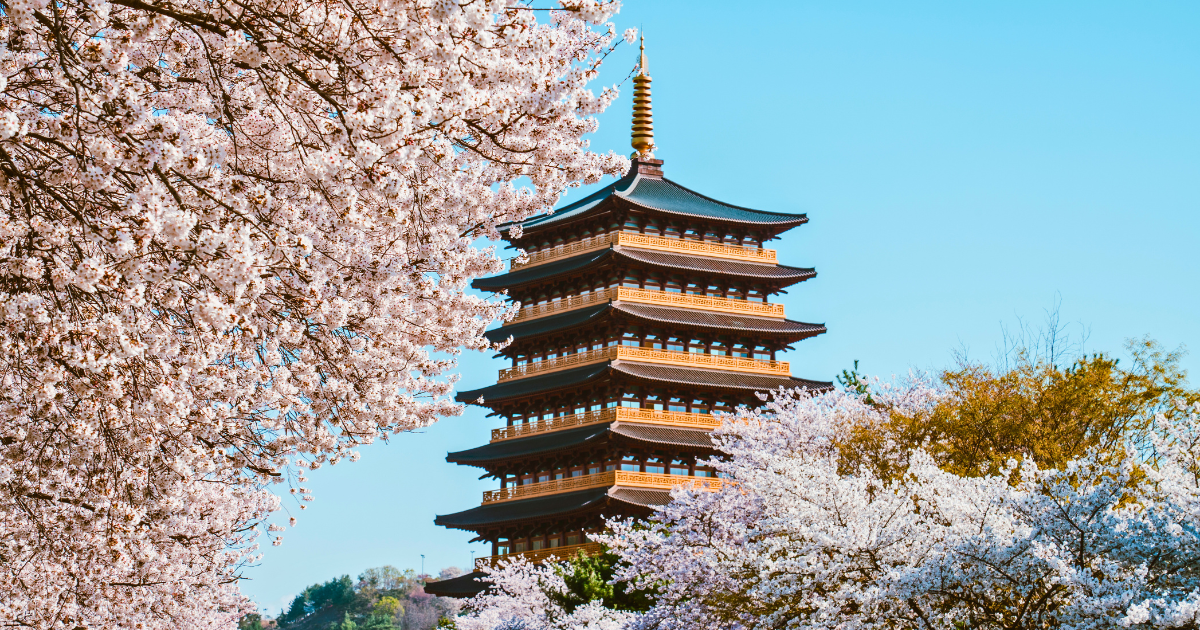
Gyeongju is one of Korea’s leading cherry blossom destinations, with historic sites set among spring blooms across the city.
Exploring Gyeongju with Asia Unbound
Asia Unbound designs private journeys across Asia, with a focus on cultural depth and itineraries that move beyond the most visited routes. Our South Korea journeys are arranged around individual interests and led by expert local guides, with carefully chosen accommodation throughout. To experience Gyeongju and its historical sites as part of a private itinerary, contact our team to begin planning.