
Exploring Arashiyama And The Bamboo Groves Of Kyoto
Kyoto sits in a basin ringed by forested hills, and its western edge is where the city begins to give way to the slopes of the Arashiyama mountains. The Hozu River cuts down from the gorge here, widens, and takes the name Katsura as it flows past the foothills. For centuries this was the edge of the old capital, close enough for the Heian court to reach by carriage and far enough to feel like an escape from it.
Heian aristocrats came from the 9th century for cherry blossom viewing, moon watching and seasonal poetry, and the area kept its associations with retreat through the centuries that followed. Zen temples were built into the lower slopes, villas into the hillsides, and a path between them ran through stands of cultivated bamboo on the way up to the higher ground.
That path is now the Sagano Bamboo Grove, the image most travellers carry of the district before they arrive. The grove draws the crowds, though Arashiyama holds more than the short walk through the stalks. The Togetsukyo bridge in Kyoto anchors the riverfront, Tenryu-ji and its 14th century garden sit at the foot of the hills, and quieter temples are tucked into the slopes above.
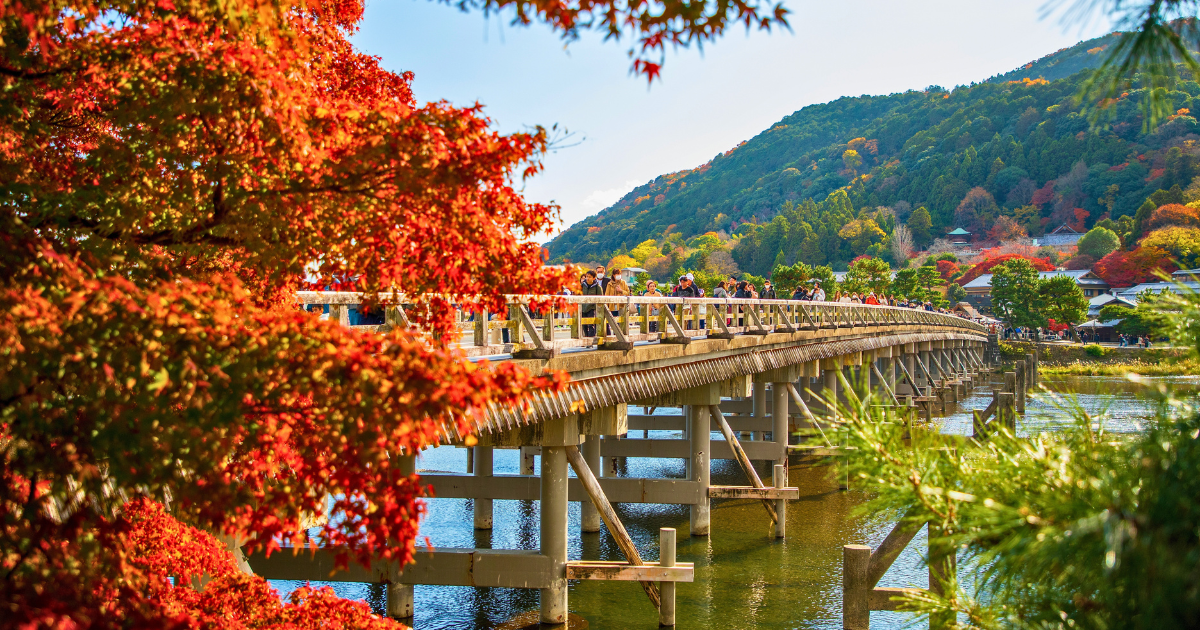
The current Togetsukyo bridge dates to 1934 and uses reinforced concrete clad in cypress, keeping the silhouette of the structure that has stood at this point since the 9th century.
What is Arashiyama known for?
Arashiyama takes its name from the mountain that rises directly above the Katsura River, and the district sits at its base on both banks. The area is best known for four things that sit within walking distance of each other: the Sagano Bamboo Grove, the Togetsukyo bridge, the Zen temple of Tenryu-ji, and the wooded hillside paths that connect them. Most travellers arrive for the grove and stay for the wider walk.
The area has a different feel from the temple districts in eastern Kyoto, since the hills shape the experience throughout. Tenryu-ji's garden was designed in the 14th century to draw the Arashiyama slopes into its composition, and the same slopes frame the bridge, the riverside walk and the bamboo path above it. Cherry blossoms line the Katsura in early April, and the Sagano hills turn red and gold through November.
Behind the bridge, Arashiyama is also a regular western Kyoto neighbourhood. The streets hold residential blocks, small shrines and family-run restaurants, and the rail lines that bring visitors in also carry commuters further into the hills.
Is Arashiyama worth visiting?
Yes, and timing makes a real difference. The grove and the bridge are quietest before about 9:00am or after the day-tour groups leave in the late afternoon, and the light through the bamboo is also better at those hours.
Half a day covers the core circuit of Tenryu-ji, the grove, the bridge and a riverside lunch. A full day allows for the hillside temples north of the grove, the Sagano Romantic Train along the Hozu gorge, or a return trip by river boat from Kameoka. Most travellers find a morning or afternoon here adds something to their Kyoto stay that the eastern temple districts do not.
Six must see destinations in Arashiyama
The main sights cluster on a loop that starts at Tenryu-ji, runs north through the bamboo grove, climbs into the hills around Okochi Sanso, and comes back down to the river at the Togetsukyo bridge. The whole circuit covers about three kilometres on foot and takes a half day at an unhurried pace, which makes it a natural inclusion in a more in-depth Japan itinerary. Travelers with more time tend to add the smaller temples north of the grove, where the crowds thin out and the walking becomes the point.
Sagano Bamboo Grove
The Sagano Grove is the headline image of the district and the centrepiece of any Arashiyama bamboo grove guide. The main path runs about 400 metres between the north gate of Tenryu-ji and the entrance to Okochi Sanso villa, with stalks rising 10 metres or more on either side. Bamboo was cultivated on these slopes for centuries before tourism arrived, used for tea utensils, baskets, fencing and the construction of temple interiors, and the grove sits on what was once a managed crop.
The sound is the part that photographs miss. Wind moving through the stalks produces a low creak and rustle that the Japanese Ministry of the Environment included in its 1996 list of 100 soundscapes worth preserving. Early mornings and overcast days are when the path is at its best, both for the sound and because the diffused light through the canopy reads more clearly than direct sun. By midday in peak season the path can move shoulder to shoulder, so the early start pays off twice.
Togetsukyo Bridge and Katsura River
The Togetsukyo bridge crosses the Katsura at the southern edge of the sightseeing district and forms the visual anchor of Arashiyama. The name translates as "moon crossing bridge," attributed to a remark by the 13th century Emperor Kameyama as he watched the moon appear to track across the water. A bridge has stood at this point since the 9th century, though the current structure dates to 1934 and uses reinforced concrete clad in cypress to keep the older silhouette.
The bridge connects the temple side of the district with the southern bank, where the streets lead to the Iwatayama monkey park and a stretch of riverside boat operators. The view upstream towards the Hozu gorge is the standard postcard shot, with the Arashiyama mountain rising directly behind. Travelers crossing in the late afternoon often catch the river boats coming in from Kameoka, which dock just below the bridge after their two-hour descent through the gorge.
Jojakko-ji and Gio-ji
Jojakko-ji sits on the hillside about ten minutes north of the bamboo grove, reached by a quiet lane that climbs through residential streets. The temple was founded in 1596 as a retirement retreat for a senior priest of the Nichiren school, and its main draw is a small pagoda set among maples that turn deep red in mid-November. The grounds are unfussy and rarely crowded, even in autumn.
Gio-ji is another five minutes further on, smaller again and built around a moss garden under a canopy of maples and bamboo. The temple's name comes from Gio, a 12th century court dancer who took religious vows here after being displaced from the affections of the warlord Taira no Kiyomori, and the story is laid out on a plaque inside the grounds. The moss is at its best after rain, when it deepens through several shades of green.
Okochi Sanso Villa
Okochi Sanso was the private residence of the silent-film actor Denjiro Okochi, built into the hillside above the bamboo grove over a thirty-year period from the late 1920s. Okochi designed the gardens himself and continued working on them until his death in 1962, drawing on traditional Japanese garden principles he studied alongside his acting career. The villa is open to the public, with a walking route that passes through tea houses, viewing pavilions and a small museum.
The entry fee is higher than most temples in the area and includes a bowl of matcha and a wagashi sweet at the end of the walk, which keeps visitor numbers low. The route climbs to a viewpoint that takes in Kyoto's eastern hills, the Hozu gorge and the rooftops of central Kyoto in the distance. For travellers willing to spend an extra hour, it is one of the calmer parts of the district.
Tenryu-ji and Sogen Garden
Tenryu-ji was founded in 1339 by the shogun Ashikaga Takauji to commemorate Emperor Go-Daigo, and it remains the head temple of the Tenryu-ji branch of Rinzai Zen. The temple buildings have been rebuilt several times after fires, most recently in the Meiji period, but the garden has survived in close to its original form. UNESCO listed Tenryu-ji as part of the Historic Monuments of Ancient Kyoto in 1994.
The Sogen garden was designed by the Zen priest Muso Soseki in the 14th century and is regarded as one of the earliest surviving examples of shakkei, the technique of borrowing distant scenery into a garden composition. The pond sits in front of the abbot's hall, and the Arashiyama hills behind the temple are pulled into the view as part of the design. The temple's north gate opens directly onto the bamboo grove, which means most visitors who walk the grove are already inside the Tenryu-ji grounds without realising it.
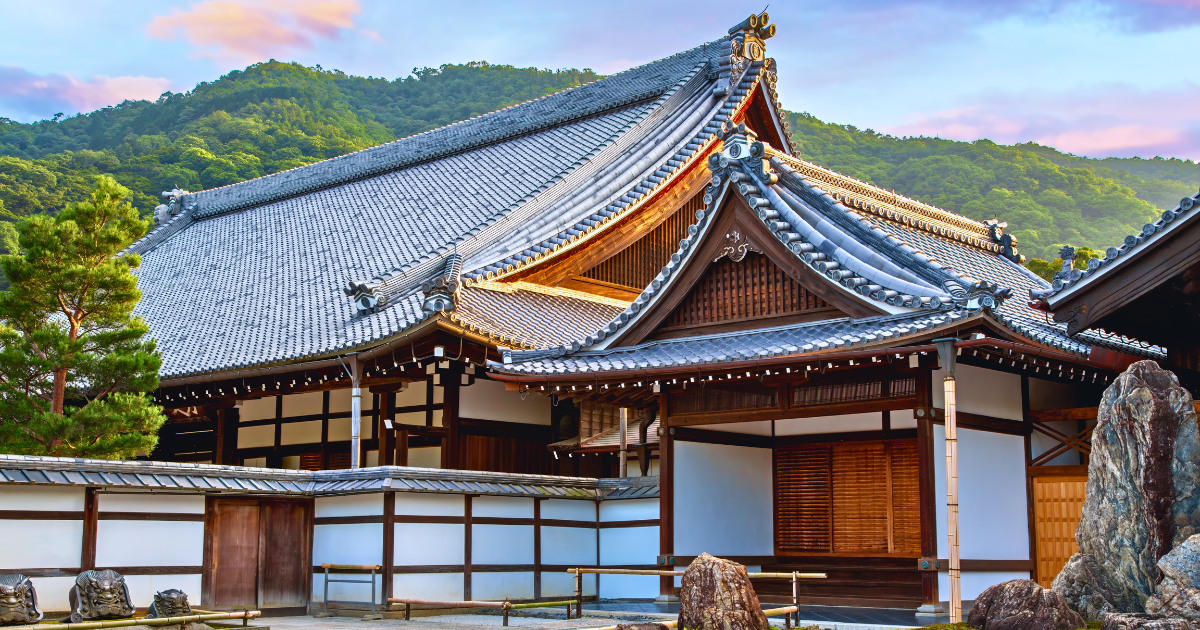
Tenryu-ji was founded in 1339 and is the head temple of the Tenryu-ji branch of Rinzai Zen, with UNESCO World Heritage listing since 1994.
When is the best time to visit Arashiyama?
Early morning is the best time to visit Arashiyama in any season. The bamboo grove is at its quietest before 9:00am, the morning light filters cleanly through the canopy, and the walk from Tenryu-ji through the grove and down to the bridge flows at an easy pace. Late afternoon, from around 4:00pm, is another good window, with softer light along the riverside and the bridge.
Autumn is the headline season. The Sagano slopes turn through orange and red from the second week of November to the first week of December, and the smaller temples north of the grove hold the colour particularly well. Jojakko-ji and Gio-ji are lovely options during this period, with maple framing at its peak and a calmer atmosphere than the larger autumn-viewing temples in eastern Kyoto.
Cherry blossoms along the Katsura River run from late March into the second week of April, and the bridge approach is one of the prettier viewing spots in western Kyoto. Winter has its own appeal, with quieter temples through January and February and occasional snow on the rooftops that few travellers get to see. Summer brings warm, lively days from late June through August, and the riverside cools beautifully in the early evening, with the boat operators below the bridge running later into the day.
How to get to Arashiyama?
Arashiyama sits about 20 minutes in Kyoto western district and is one of the easiest day trips in the city to reach. Three rail lines connect the district to the centre, each ending at a different point in the area, which gives travellers a choice depending on where the day begins.
JR Sagano line
The JR Sagano line is the most direct option, running from Kyoto Station to Saga-Arashiyama in around 15 minutes. The station sits a short walk north of the bamboo grove, which makes it a great starting point for a morning at Tenryu-ji followed by a walk south through the grove towards the bridge. The line is covered by the Japan Rail Pass, which makes it a convenient choice for travellers already using the pass.
Keifuku Randen tram
The Keifuku Randen tram is the more scenic route, running from Shijo-Omiya in central Kyoto out to Arashiyama in about 25 minutes. The tram passes through the western Kyoto neighbourhoods of Nishioji and Uzumasa, and the Arashiyama terminus is decorated with kimono-pattern pillars set in glass, which form a small attraction in their own right. The tram lands close to the bridge, which suits travellers planning to start the day at the river.
Hankyu line
The Hankyu line offers a third route, running from Kawaramachi or Karasuma in central Kyoto to Hankyu Arashiyama on the south bank of the Katsura in around 20 minutes. The station brings travellers in from the opposite side of the river, with a pleasant walk across the Togetsukyo bridge as the entry to the district. The line also connects well with onward travel to Osaka and Kobe, which makes it a good option for travellers continuing west.
By bicycle or private transfer
Travellers staying in western Kyoto can enjoy the ride to Arashiyama by bicycle along the Katsura River path, which runs north from the Katsura Imperial Villa area and reaches the bridge in around 30 minutes. Hotels in central Kyoto often arrange private transfers as well, which gives travellers an easy early start and a relaxed arrival into the district.

The Keifuku Randen tram from Shijo-Omiya in central Kyoto reaches Arashiyama in about 25 minutes, passing through the western Kyoto neighbourhoods of Nishioji and Uzumasa on the way.
Exploring Arashiyama and greater Kyoto with Asia Unbound
Asia Unbound designs private journeys and custom made itineraries across Japan, with a focus on regional depth and travel that moves beyond the most visited routes. A Japan private tour arranged by our regional specialists can place Arashiyama in the right part of the day, pair it with quieter parts of western Kyoto, and connect it into a longer route through Japan that fits the way you prefer to travel.
For travellers planning a journey through Japan, get in touch with the team to design a private itinerary, or browse our existing Japan journeys for a sense of how a trip can be put together.